Case Summaries · Utilities
Thames Water: the £3bn interim plan that bought time, and the creditor takeover still stuck with Ofwat
A £1.5bn super senior facility sanctioned under Part 26A in February 2025 pushed every class of Thames Water debt out two years and bought the company time. The full recapitalisation, and the creditor takeover that goes with it, still has to clear Ofwat.
Key terms
- Company
- Thames Water Utilities Holdings Limited (the plan company), holding company of Thames Water Utilities Limited, the UK's largest water and sewerage business, with 32,000 km of mains, 109,000 km of sewers and about 8,000 staff
- Owners
- Kemble Water Holdings, the ultimate holding company, is still owned by the legacy shareholders (OMERS, USS, ADIA and their co-investors); the February 2025 plan left their equity in place, and the London & Valley Water proposal would write it off in full. Legacy shareholders walked away from £750m of committed new equity in 2024
- New money
- £1.5bn super senior funding, plus an option for a further £1.5bn on the same terms, 2.5 year maturity, issued at 97, 9.75% cash coupon, ranking ahead of all plan debt except certain hedging
- New maturities
- Class A, Class B and subordinated debt maturity and amortisation dates extended by two years, as of 18 February 2025; the extension reverts to the prior maturity dates if the relevant class of debt becomes investment grade at two rating agencies
- Implementation
- Part 26A plan of Thames Water Utilities Holdings. Convened on 17 December 2024, creditor meetings 21 January 2025, sanctioned on 18 February 2025, appeals dismissed 17 March 2025 with reasons on 15 April 2025
- Completed
- interim plan implemented on 21 February 2025 (notice of plan effective date). The full recapitalisation (RP2) has still not launched
How we got here: Thames was loaded with debt long before the regulator said no to higher bills
Thames Water was privatised in 1989 under Margaret Thatcher's government, whose free-market privatisation programme, the defining economic project of her premiership, put state-run industries (including the water companies) into private investors’ hands for the first time. The government wrote off £5bn of debt across the ten new private regional water companies it created and handed them a £1.5bn "green dowry" of public money before their shares were floated at the end of 1989.
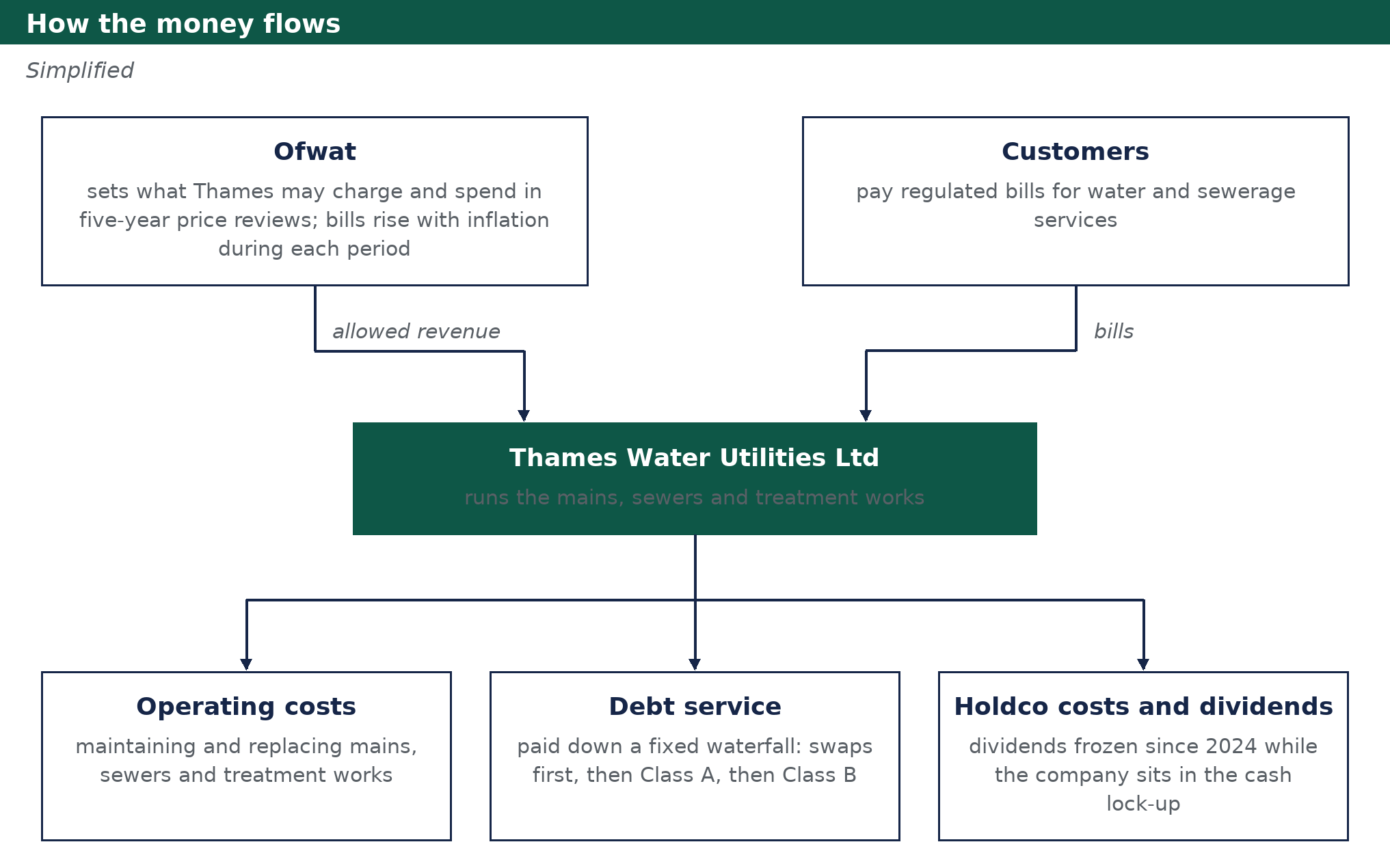
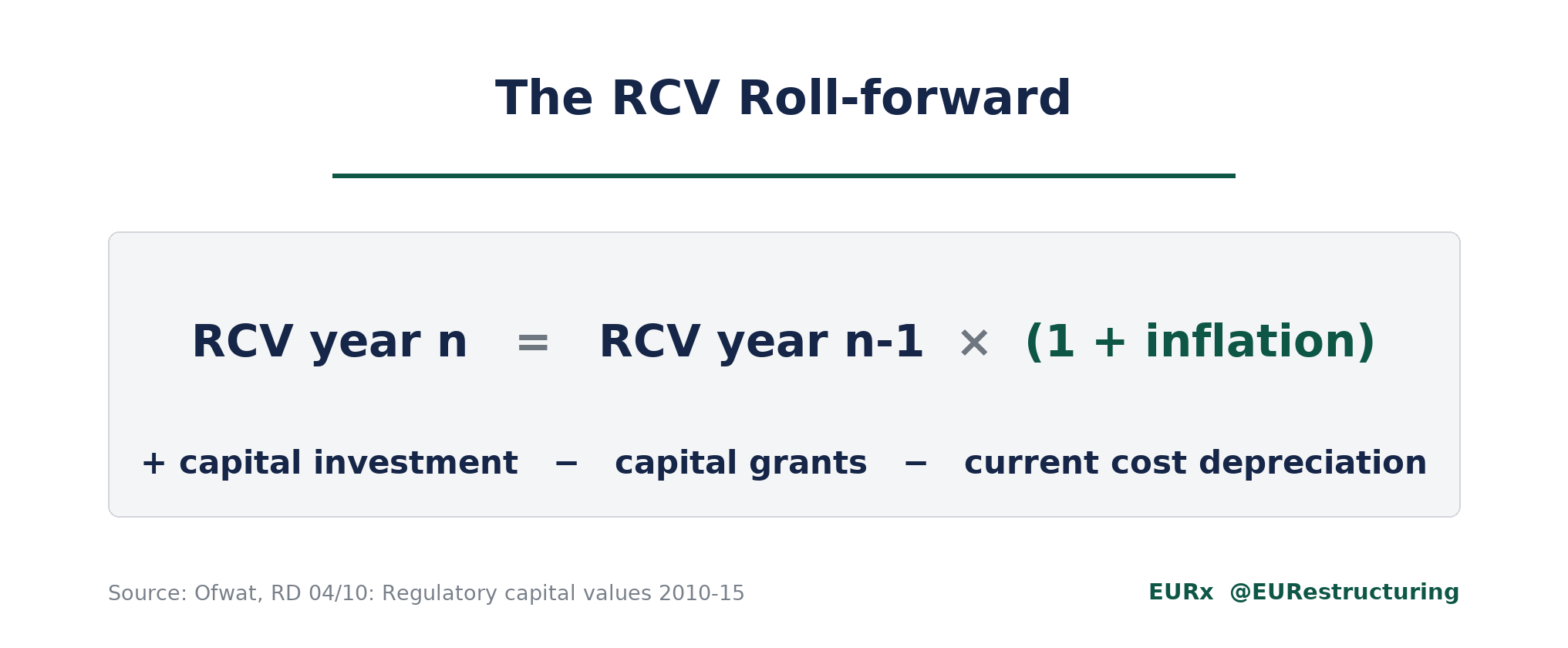
Thames Water is effectively a monopoly: it is the sole supplier of water and sewerage services to London and the Thames valley, serving about 15 million people, and its revenue comes exclusively from customer bills. Those bills are set by Ofwat, the industry regulator, in five-year price reviews that fix what the company may charge and spend. The business is capital-intensive: its cost base is dominated by the fixed network of mains, sewers and treatment works, which need to be routinely maintained and replaced. Customer bills rise with inflation plus whatever performance incentives the company earns. The number that anchors the company's regulatory financial model is the Regulatory Capital Value (RCV), the notional capital base the company is allowed to earn a return on, which grows with net investment and inflation and in effect decides how much debt the business can carry.
In the event these companies ever became insolvent, the government created a concept called a Special Administration Regime (SAR). Part of the 1991 Water Industry Act, SAR provides that on the application of the Secretary of State or Ofwat, a court may appoint a special administrator (an insolvency practitioner) to run the company, and the statutory purpose is the continued provision of water and sewerage services without regard for creditors' recovery. Thus, a special administration can force deeper write-downs on lenders as it deems necessary.†††
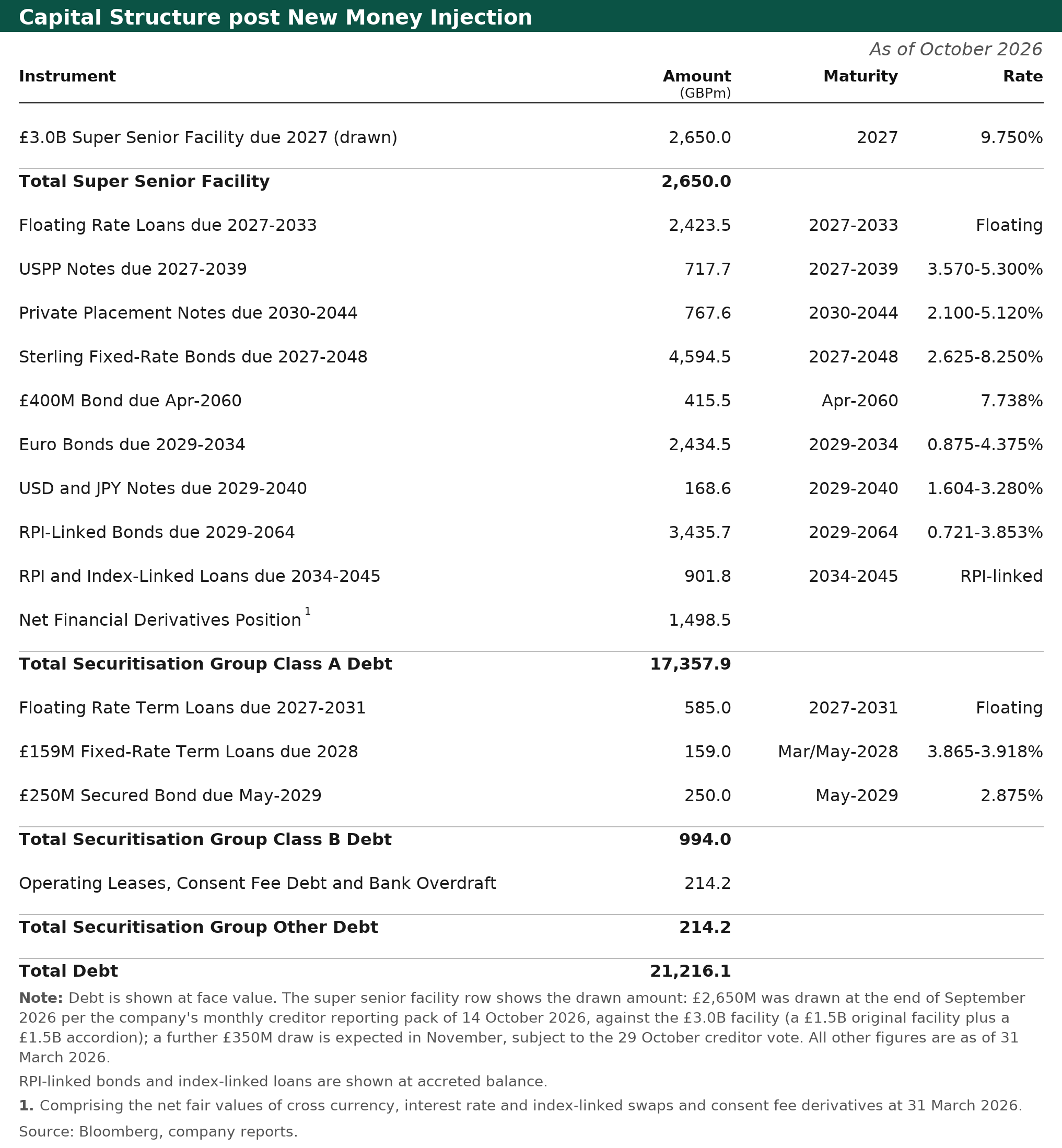
Throughout its time as a private enterprise, Thames has carried leverage. Its debt was structured via a whole business securitisation rather than as straight corporate borrowing, and the securitisation debt sat in tiers. By 2023, Class A debt totaled about £16bn split between loans and bonds; Class B, roughly £1bn, ranked behind it. Below both sat about £3.5bn of subordinated debt owed to the group's own parent; and the holding companies above the utility (known as Kemble) carried debt of their own.
Much of the Class A debt is index-linked, so its principal and coupons rise with inflation. The securitisation was issued through Cayman Islands vehicles until early 2018, when the group moved to close them after the structure drew sustained public criticism, replacing the Cayman issuer with the UK-registered Thames Water Utilities Finance (TWUF). Index-linked swap agreements rank super senior to the Class A bond and were provided mostly by banks and insurers.
Everything except the subordinated debt shares one security package: first fixed charges over the shares in Thames Water Utilities Limited and its finance subsidiary, the group's land and property, plant and machinery, bank balances, intellectual property and book debts, governed by about 60 documents including a security trust and intercreditor deed and a common terms agreement. The plan company guarantees the Class A and Class B debt of the utility and its finance subsidiary, with a deed of contribution between the three covering payments under debt ranking ahead of the subordinated debt. The subordinated debt included £1.98bn of principal plus £1.25bn of accrued interest owed to its parent, with £331m of further demand loans alongside it.
Ofwat fixes the allowed return by reference to a weighted average cost of capital calculated on a notional capital structure, sets revenue allowances in real terms, and indexes them to inflation forecasts with a true-up once actual inflation is known. Revenue allowances are indexed to CPIH, the consumer prices index including owner occupiers' housing costs, while much of the company's index-linked debt is tied instead to RPI, the retail prices index. Water companies can seek adjustments to their allowed bills and spending through the price review process: the companies submit business plans, the regulator issues a draft determination for consultation, there is scope for negotiation on the key points, and a final determination follows.
In 2001, RWE, the German utility, took Thames private again for £4.3bn in cash, assuming £2.5bn of debt the company had amassed through the 1990s to pay for its capital investment programme (and dividends). In December 2006, a consortium led by Macquarie acquired the business for £8.5bn, writing a £2.3bn equity check and funding the rest with debt. Dividends ran at £656m in 2007, the consortium's first year of ownership, against profits of £241m. From 2006 to 2017, the Macquarie consortium extracted £2.8bn, two fifths of all dividends Thames Water paid between 1990 and 2022, while debt roughly tripled from £3.4bn to £10.8bn over the same period.
Macquarie opted to exit in 2017, selling its remaining 26.3% stake in Kemble Water, the ultimate holding company, to OMERS (already a shareholder) and Wren House, the Kuwait Investment Authority’s infrastructure arm, in March 2017. At that point, Thames was owned by OMERS (31.8%), Universities Superannuation Scheme (USS) (19.7%), ADIA (9.9%), British Columbia Investment Management (8.7%), Hermes (8.7%), China Investment Corporation (8.7%) and Queensland Investment Corporation (5.4%).
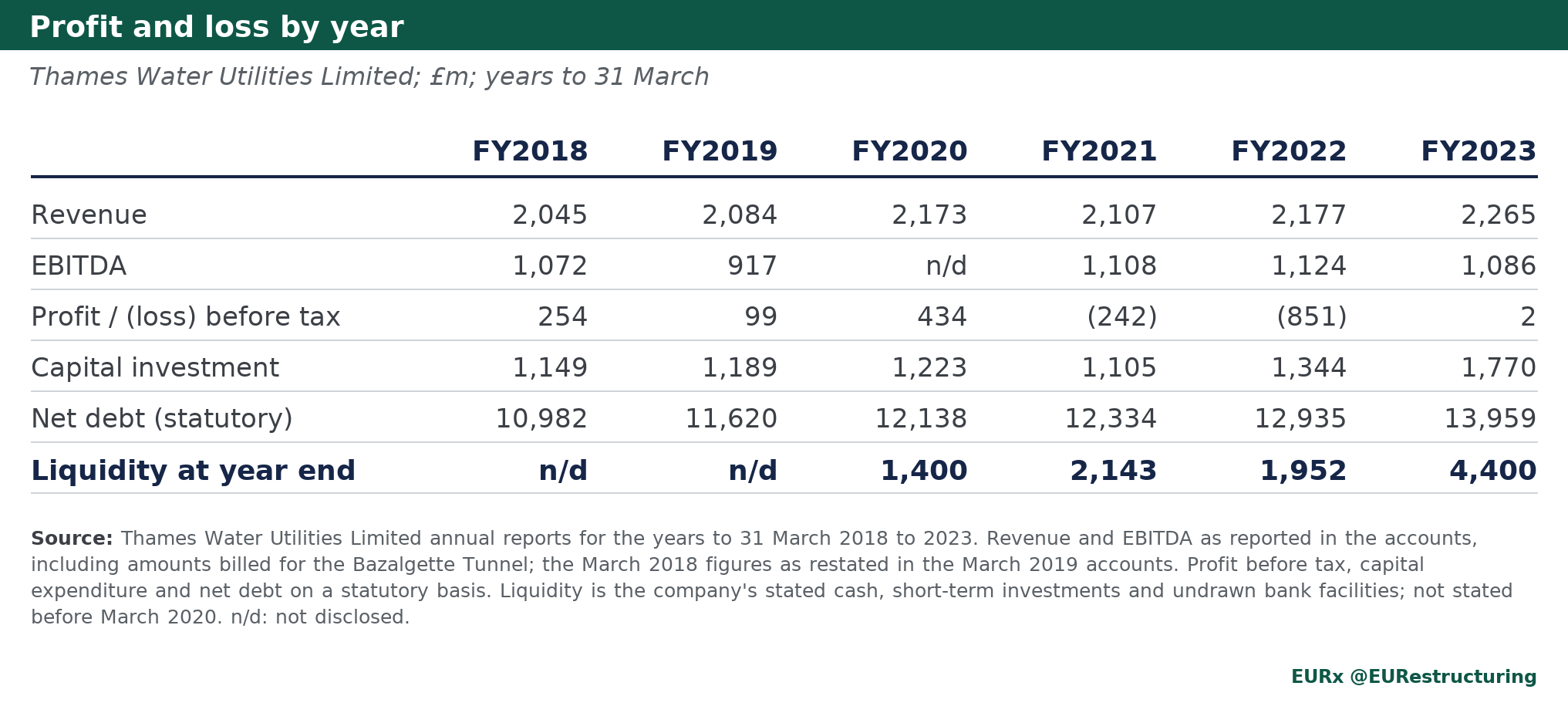
Thames ran on predictability throughout much of its history, but the early 2020s brought the opposite: a global pandemic, war, and the subsequent return of rising interest rates from years of near-zero post financial crisis. It was all of these factors, but inflation in particular, that squeezed the business from both sides. The 2019 price review had set bills in real terms, so when energy, chemicals and labour costs surged from 2021, revenues pegged to CPIH no longer kept pace with the cost base††††. The chart below tracks the decline: revenue barely moved over six years, profit before tax swung from £254m in 2018 to an £851m loss in 2022, and net debt rose by ~£3bn to £13.96bn.
Burning cash and with its debt load swelling, Thames needed new equity to plug the leak. The shareholders chipped in with £500m in March 2023, the first equity injection since privatisation, and £750m of emergency funding by July (with a further £2.5bn indicated to 2030), but it was not enough. In March 2024 they declined to fund the additional £750m, concluding the company's own business plan was in their words “unfinanceable and uninvestible", and walked away from the business. OMERS wrote its 31.7% stake down to zero, and other shareholders followed suit. From April 2024, Thames stopped paying interest on the Kemble holdco facilities, starting with a £190m loan due that month, and subsequently defaulted on the rest. Debt began changing hands into distressed investors across the capital structure; through 2023 and 2024 funds including Elliott, Apollo, Sona and Silver Point bought at deep discounts across Class A debt, pricing in a restructuring.
In the summer of 2024, Thames was in the middle of Ofwat's 2024 price review, which sets the company's allowed bills and business plan for 2025 to 2030. Thames's proposed plan for 2025 to 2030 had asked to raise bills by 44%. In its draft determination for 2025 to 2030 issued on 11 July 2024, Ofwat allowed £16.9bn of total expenditure against the £22.2bn in Thames's business plan. Thames's response, submitted on 29 August 2024, put the plan's total expenditure at £24.5bn. The final determination on 19 December 2024 allowed £20.5bn. Thames said hitting its targets on that budget would be "incredibly challenging". Fines added to the pressure: Ofwat proposed a £104.5m penalty under an enforcement order for its wastewater operations in August 2024, and an £18.2m penalty tied to interim dividends of £37.5m paid in October 2023 and £158.3m in March 2024 (ratings downgrades forced the company to seek Ofwat approval for dividends). Ofwat's final determination allowed bills to rise by just over a third by 2030, versus the 59% Thames was by then requesting, or £228 a year on the average bill by 2030, leaving the investment programme and the debt service bill to be met from a smaller allowance. Unhappy with the decision, Thames asked Ofwat to refer the determination to the CMA on 24 February 2025.††
At 31 August 2024 Thames had £1.57bn of liquidity, including £550m of undrawn reserve facilities and £380m of cash locked in reserves. The court accepted that the runway ended on 24 March 2025, when £209m of Class A debt plus £15m of interest fell due, with a further £3.55bn maturing between July 2025 and April 2027. Without new money, the directors would have had to ask Ofwat and the government to put the company into SAR. In September 2024 S&P cut the Class A debt five notches to CCC+ and the Class B debt to CCC-, and Moody's cut the corporate rating to Caa1, each citing the tightening liquidity position.
With the future of the company in serious jeopardy, Thames frantically searched for a white knight. The Guardian reported on 1 April 2024 that Thames had appointed Teneo, the adviser that ran the special administration of the energy supplier Bulb, and that Teneo would be in line to run a special administration if the company tipped into one. Thames had also appointed Rothschild & Co to work on its financing, and Rothschild launched the pre-marketing phase of an equity raise on 12 July 2024, the day after Ofwat published its draft determination. Bloomberg reported that a process to raise at least £3.3bn of new equity was under way by October 2024, and by December the BBC reported up to six interested parties, among them Covalis Capital, Castle Water and CK Infrastructure, the Hong Kong group behind Northumbrian Water. None of it came to anything: the bids on the table either required write-downs of the Class A debt that the Class A creditors would not accept, or, like Covalis Capital's £5bn bid with Suez, relied on selling off assets and floating the remainder, an approach the company's chief executive dismissed as a distraction from fixing leaks and sewage spills. In addition, the unresolved price review and the lack of clarity over returns deterred others. With no buyer agreed, no rescue financing from the government and special administration still in reserve, the only option left for Thames was to put a restructuring to the creditors. On 10 December 2024, the plan company issued its application for a restructuring plan under Part 26A of the Companies Act 2006, the route for companies at risk of insolvency that are not yet in formal insolvency proceedings.
Opposing creditor groups gear up for a fight
A Class A creditor group moved first, offering the company a backstop: £1.5bn of super senior funding issued at 97, with a 9.75% cash coupon and a two-and-a-half-year maturity, ranking ahead of all plan debt except certain hedging, plus a 3.5% backstop fee. Through Akin Gump, the group said it held more than £12bn of debt across more than 100 institutions. Its coordinating committee included Abrdn, Apollo, Assured Guaranty, BlackRock, Corebridge, D.E. Shaw, Dexia, Diameter, Elliott, GoldenTree, Insight, Invesco, MetLife, PIMCO, PRICOA, Silver Point, Sona and Voya†.
A Class B group advised by Quinn Emanuel and led by Polus Capital Management and FitzWalter, which said it held over 75% of the Class B debt (around £746m), sent its own backstop proposal on 7 November 2024. The offer landed a fortnight after the Class A group had already signed its transaction support agreement, and the company stayed with the Class A package; the Class B group took its challenge into the sanction hearing instead.
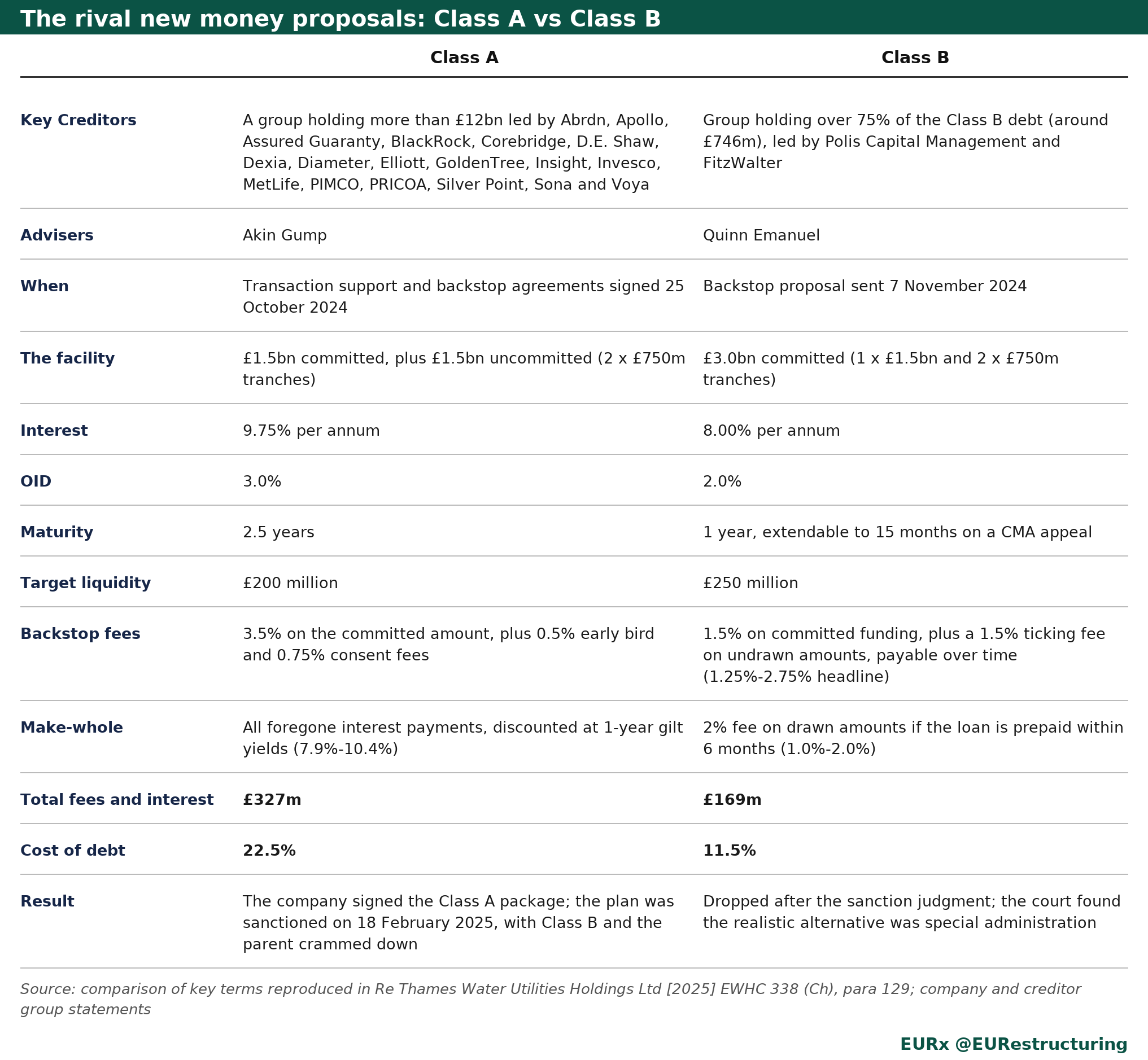
The proposed package also carried control terms that barred voluntary repayments of Class A or Class B debt during the stable platform period and tied the later tranches to the June Release Condition. Opponents said about £800m of the £1.39bn available over six months would go on interest and fees.‡‡
The Class B group proposed its own plan on better economics, including a backstop fee of 1.25% to 2.75% against 3.5%. The Class A group said that if the Class B plan went forward it would propose a third plan on the company's terms.
The Class B group's main target was the "June Release Condition". Later tranches (£462m of the first £1.5bn plus all of the second £1.5bn) were only available if, by 30 June 2025, a lock up for the recapitalisation had the support of two thirds of the super senior lenders and two thirds of the Class A debt. In practice that handed the senior creditors control over what RP2 would look like. Ultimately, after hearing the arguments and reviewing the expert evidence, the judge found that the realistic alternative to the company's plan was the SAR request scenario, not the Class B plan, and the Class B plan was dropped soon after judgment.
Valuation decided the fight. The Class A group’s valuation expert, Eraj Weerasinghe of Kroll, put enterprise value at £14.7bn at the valuation date, £16.7bn at 30 September 2025 and £18.76bn at 31 July 2026. The Class B group’s expert, Dora Grunwald of Osborne Partners, said £21.5bn. On the company's numbers Class B would have received nothing in a SAR scenario, so continuing interest under the plan left it no worse off, and the court sanctioned the plan over their objections using the cross-class cram down‡. The court rejected a competition law attack on the June Release Condition. Charlie Maynard, an MP whom the court allowed to appear to represent the public interest and customers, argued that special administration would better protect customers; the court held he had standing but sanctioned the plan anyway.
On appeal the court applied Adler, and this time the plan survived
The Class B group (via Polus), Thames Water Limited and Charlie Maynard, each appealed the sanction order. The group argued the plan was unfair because the Class A creditors received valuable non-financial rights, including their seat on the joint restructuring committee and information rights that the Class B creditors were not given, and that the releases of claims against directors and advisers were unfair. Thames Water Limited argued that, having found the Class B creditors out of the money, the judge still had to ask whether the plan was fair and conferred unjustified benefits on the Class A creditors. And Maynard argued that, where the alternative was a special administration, the judge should have given priority to the public interest and customers' interests over private creditor interests (he also highlighted the Class A costs). The Court of Appeal dismissed all three on 17 March 2025. Its only change was to narrow the release of claims against directors and advisers. It applied its own test from Adler, where it had set aside a plan for unfair sharing of the restructuring surplus, and found no unfairness here: the Class B creditors were out of the money and the control terms did not move value away from them.
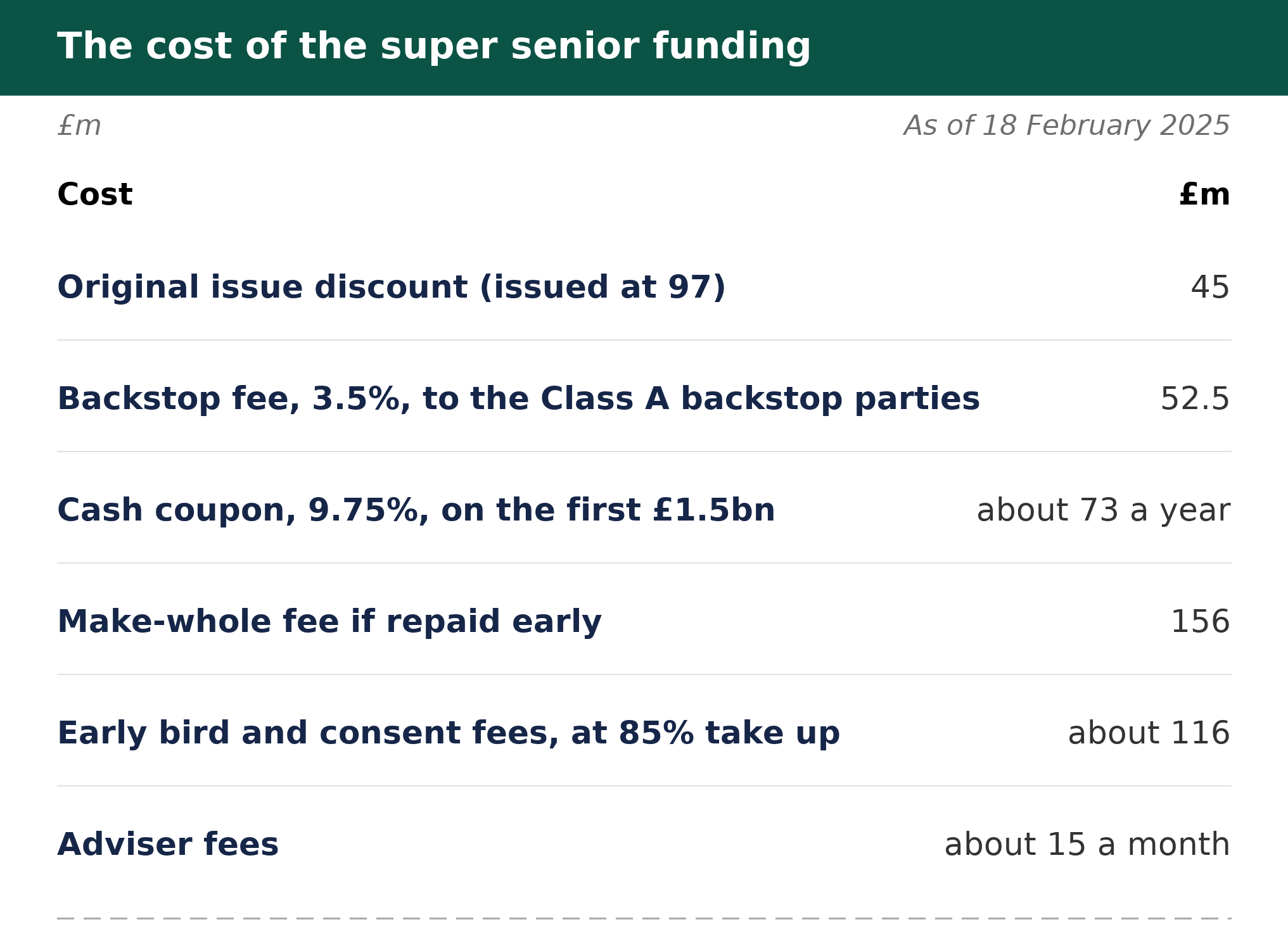
On 25 October 2024, Thames signed the transaction support agreement and a backstop agreement for the new money with the group of Class A creditors. The agreement committed the signatories to provide £1.5bn of super senior funding, with an option for a further £1.5bn on the same terms: a two-and-a-half-year maturity, issued at 97 with a 9.75% cash coupon, ranking ahead of all plan debt except certain hedging, and a 3.5% backstop fee (£52.5m) plus a 0.5% early bird fee and 0.75% consent fees for the backstop parties. The plan it supported extended the scheduled maturities and amortisation of the Class A, Class B and subordinated debt by two years, reverting if a class returned to investment grade at two rating agencies, cancelled undrawn commitments under the liquidity facilities and the Class A and Class B debt, barred voluntary repayments of either class during the stable platform period, released the directors and advisers from creditor claims, and left the Class B creditors with little more than continued interest. The new money package carried £327m of fees and interest, against £169m under the Class B group's rival proposal.. The super senior funding was drawn monthly from February to August 2025: £293m, £25m, £333m, £156m, £231m, £350m and £112m. Fifteen sets of consent requests have been put to the super senior creditors since the plan completed, and all fifteen have been approved. As of 15 October 2026 the company had drawn £2.65bn of the £3bn available under the super senior facility, being the original £1.5bn from the plan plus £1.5bn of accordion commitments secured since. The company will have incurred almost £2bn in financing costs and advisory fees over the eighteen months to the end of September.
Alongside the plan implementation, Thames continued to search for a buyer. In March 2025, it named KKR as its “preferred partner” in a proposal reported to be worth about £4bn of new equity and to involve a material impairment of the Class A debt. But KKR ended up walking away on 3 June 2025, with political and regulatory risk reported as a factor, and the company's bonds, which had rallied on the headlines, touched new lows.
After KKR's exit the Class A creditors came together as the London & Valley Water consortium, a group of about 100 institutions holding more than £17bn of Class A and super senior debt. Discussions between the consortium, the company, Ofwat and the other regulators have been running since June 2025, per the company, and the consortium put its first full proposal to the company and to Ofwat on 2 October 2025. The 16 March 2026 proposal offered £3.35bn of new equity and up to £6.55bn of new debt to fund £20.4bn of spending over 2025 to 2030, with a 30% write-off of Class A debt (confirmed by the company) and write-offs in full of Class B debt, subordinated debt and existing equity, a package the consortium says involves creditors writing off £9.6bn of debt in total. It also promised no dividends before 1 April 2035. The recapitalisation itself would be implemented through a scheme of arrangement under Part 26 or a restructuring plan under Part 26A of the Companies Act 2006, once a lock-up agreement is reached with the financial stakeholders. The consortium is currently asking Ofwat to waive certain penalties until March 2030 in exchange for a one-off £800m payment to the business, and is planning a stock market listing of the restructured business as early as 2030.
The UK government wasn’t satisfied
On 16 June 2026 Emma Reynolds, then the Environment Secretary, wrote publicly to Ofwat about London & Valley Water's best and final offer, received on 6 March 2026. The letter set out the parts of the proposal she was "not yet convinced" about: prioritising asset health over capital improvements, switching off parts of the penalty regime, amending risk-sharing mechanisms, and asking consumers to fund an unacceptable level of regulatory adjustments. It stopped short of a direction, leaving the decision formally with the regulator. On 18 September 2026 the Commons environment committee urged the government to reject the consortium and reconsider SAR, noting gearing of 86 to 88%, the highest of any English water company and (in their view) an unsustainable debt load any public utility.
Andy Burnham, who became prime minister on 20 July 2026, has been one of the water industry’s most prominent critics in government. As Greater Manchester mayor and then as Labour leadership candidate he called for public control of the sector, and during the June 2026 Makerfield by-election campaign he said nationalising Thames Water “is what should be done”. Most recently he has asked officials to prepare more radical options for taking Thames Water into public control, with a bill in preparation to clear the legal path for taking water companies into public ownership (no statute prohibits the government from owning a water company, but bringing one under public control would require new primary legislation) and could rewrite the special administration regime. The creditor consortium has responded with its own offers to appease the new government: investors providing £10bn of new capital with no taxpayer funding and no increase in customer bills, a ‘golden share' for ministers and a new public-interest supervisory structure with local authority and regional representation, a commitment to lock up a significant proportion of their equity and to share outperformance returns with customers at any listing, and a statement that no environmental leniency has been requested. It reinforced the pitch on 20 October 2026 by naming Lord Hutton as independent chair designate of the board it proposes, with Mike McTighe as vice-chair designate. The proposals under discussion involve creditors writing off £9.6bn of loans, and a bespoke settlement with Ofwat rather than any new statutory regime: a one-off payment in exchange for Ofwat waiving penalties until March 2030.
Latest financials and ratings action
Thames's annual report for the fiscal year through 31 March 2026 shows underlying revenue of £3.62bn and underlying operating profit £1.28bn, leaving underlying profit after tax of £204m, but a net cash outflow before funding of £1.13bn and £2.68bn of capital investment left the business reliant on its creditors, who provided £1.57bn of new debt in the year. Covenant net debt, measured under the creditors' common terms agreement and excluding shareholder and certain intercompany loans, rose £2.05bn to £19.77bn and senior gearing to 86.1% (87.0% unadjusted), against a stated RCV of £22.73bn, and the company paid no dividends in the year. Liquidity was £1.04bn at the year end, £551m of it available cash, and £588m at 30 June 2026. The monthly creditor reporting pack from 14 October 2026 shows available cash at the end of September of £207m, excluding £165m held in the super senior issuer, against £2.65bn of super senior funding drawn.
S&P cut Thames Water Utilities and its finance arm TWUF to CCC- on 27 October 2026, with a negative outlook, saying the plans to extend debt maturities and increase borrowing under the super senior facility reflected a distressed financial position, and warning of possible default if creditors are not adequately compensated as the restructuring drags on. Its September 2026 update treats the February 2025 maturity extension as a default: the Class A issue rating is CCC with a recovery rating implying 50 to 70% recovery, and Class B sits at C. The agency expects the second stage of the restructuring to result in write-downs of the Class A and Class B debt, and it has said any further maturity extension would be an event of default. Moody's rates the corporate family Caa3 stable, downgraded the Class A bonds to Ca in July 2026 on lower expected recovery rates, rates Class B C, and assigned B2 to the £1.34bn super senior bonds due October 2027.
That liquidity was made up of £551m of available cash across the group and £487m of undrawn committed facilities, £73m of the initial super senior facility and £414m of the accordion, all of it held within the super senior issuer, Thames Water Super Senior Issuer plc, and reachable by the operating company only with creditor consent. The £73m is deferred until the full super senior funding, including the accordion, has been drawn, and the group has not yet sought commitments for the remaining £677m of the accordion. The investor presentation puts liquidity at £1.7bn at March 2025, £1.0bn at March 2026 and £0.6bn at June 2026. The directors' going concern statement carries a material uncertainty: they believe the group has adequate resources for twelve months from approval of the accounts, but say it is uncertain whether it can extend its liquidity runway to deliver a recapitalisation by a court-approved restructuring process within that period or at all.
The June Release Condition has been extended rather than met. As amended on 24 November 2025 it required a supported lock-up agreement for the second plan by 28 November 2025. The fifteenth set of consent requests, launched on 29 September 2026, pushed the condition to 31 October 2026 and allowed a further £170m drawdown under the super senior facility in October. The sixteenth set, launched on 15 October 2026, asks to extend the condition to 30 November 2026, to waive conditions and provide a further £350m, the fourth accordion closing, by 30 November 2026, and to increase the maximum available under the facility by £2.4bn (to £5.4bn), sought in tranches over the coming months through a newly incorporated super senior funding vehicle, Thames Water Super Senior Upsize Issuer plc, an indirect wholly-owned subsidiary of the utility. The company's own forecast is that the facility as it stands provides liquidity only until the end of 2026 or the start of 2027, and it does not expect the recapitalisation to be completed before then. The vote on the sixteenth consent requests is set for 29 October 2026, a consent vote on the upsize rather than a vote on the second plan, which has not been launched, when the STID consent of the Majority Creditors and the super majority consent of the super senior issuer's secured creditors must be in.
The package runs through three proposals under the security trust and intercreditor deed: amendments to the common terms, master definitions and trust deed documents to accommodate the new issuer; a waiver of the defaults that would arise from the proposed steps to implement an interim restructuring plan, RP 1.5; and a permanent consent allowing any obligor with no remaining obligations to resign from the group. Of the £350m fourth accordion, £276.5m is the unspent allocation from the second accordion tranche and £73.5m comes from creditors who received allocations in the first plan but were unable to or elected not to fund during the appeal period.
As of 16 October 2026 the company said it does not currently have sufficient certainty that the second plan can be implemented before certain senior debt matures and the stable platform period expires in March 2027, and that its parent intends to implement a further interim transaction to extend both. It also said it intends to keep servicing interest on the Class A and Class B debt in full in cash until any recapitalisation completes.
The Class Bs (and PIMCO) score concessions
On 16 October 2026, after much negotiation the company signed a new transaction support agreement with creditors holding more than 60% of the Class B debt, with support from certain Class A creditors. The recapitalisation still contemplates a write-off in full of the roughly £1bn of Class B debt, but now the Class B creditors would receive equity giving a recovery of about 5.9c (previously was even closer to zero), the right to participate in £150m of any new equity, and participation rights in certain additional tiers of new debt or preferred equity (plus payment of certain costs, and consent and work fees on implementation). The proposal still needs the support of holders of at least 66.66% of both the Class A debt and the super senior debt, and is expected to be implemented through a second restructuring plan.
Set beside the litigation, the deal closes the circle the Court of Appeal left open. The court had refused to let an out of the money class be expropriated without compromise, while approving a plan that left the Class B creditors with little more than continued interest. Ten months later the same class agreed, by negotiation, to a full write-off for a (potential) 5.9% recovery.
The Class B creditors support both the further interim extension and the recapitalisation only if the Class B terms are included in any recapitalisation the group proposes and assuming Ofwat has launched a public consultation on the recapitalisation on or before 30 December 2027. The company is careful on both sides: there is no certainty the recapitalisation will be finally agreed or that the Class B terms will ultimately be implemented, and the agreement imposes no obligation on the company to propose one.
The £2.4bn upsize still needs Pimco's support. The company and some of its creditors have offered the asset manager a compromise on its proposed £2.4bn raise in exchange for its endorsement. Pimco holds only the super senior debt and was concerned its position would be diluted, because the additional amount was set to be allocated proportionally between the super senior creditors and the holders of the lower-ranking Class A and Class B debt. Under the potential compromise, the first £600m would be allocated across the three tiers and the remaining £1.8bn would go to an expanded pool of super senior holders, a larger share of the new money for the top-ranked creditors.
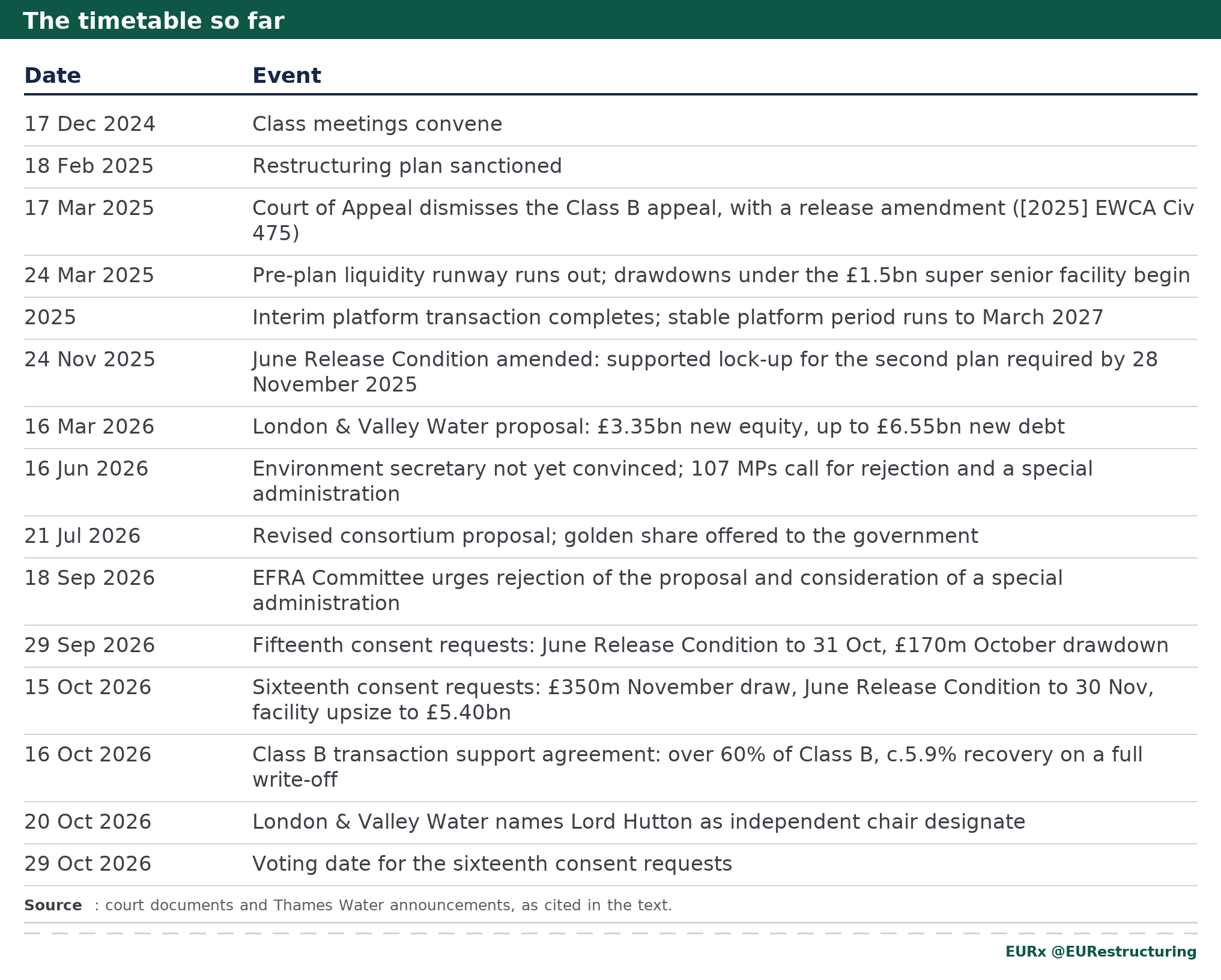
The timetable thus far
The paper trades on the odds of special administration
Thames debt has been largely illiquid since the group entered court proceedings for its restructuring in late 2024, and recent headlines and political developments have only added to the uncertainty. That said, paper continues to trade, largely by appointment, and the latest quotes put the Class A debt in the low to mid 50s context, and the Class B debt in single digits territory (aided by recent headlines).
Ofwat's answer, and whether cash lasts until it comes
The sixteenth consent requests vote is set for 29 October 2026.
The further interim extension. The parent plans to extend the maturities of certain senior debt instruments and the stable platform period, which expires in March 2027.
The Ofwat consultation. The Class B deal depends on Ofwat opening a public consultation on the recapitalisation on or before 30 December 2027.
The 2025-26 performance determinations. On 14 October 2026 Ofwat published draft determinations for the 2025-26 performance year under the outcome delivery incentive regime, proposing a net £240m reduction in customer bills, of which £107m is to be returned to customers in bills in 2027-28. Yorkshire Water and Thames Water face the largest underperformance payments, to be taken off bills in April 2027, at £75m and £46m respectively. Final determinations are due by 15 December 2026.
The water bill and special administration reform. At the Labour conference on 29 September Burnham confirmed that Angela Eagle will present a strengthened water bill to Parliament, its centrepiece the repeal of Margaret Thatcher's "ideological ban" on the public ownership of water companies, the start of what he called a ten-year journey to a new water system, with new powers for regional mayors to hold water companies accountable and tighter rules on executive bonuses. The bill could also rewrite the special administration regime.
The government's options are widening. The Guardian reported on 19 October that Burnham has told officials to rip up their plans for fixing Thames Water and come back with more radical options, an early test of his promise to bring the essentials of life under public control. One option under discussion is converting the roughly £100m of unpaid environmental fines into a government stake in the company, with the state's share rising if the company is fined again. The harder route would strip Thames of its licence, put it into special administration immediately and bring it out without offering anything to the existing creditors, a plan that would be contested in court. Advisers believe they can go further with Thames than with other water companies because international investors see it as a unique case rather than a template. On 23 October the Guardian reported that Angela Eagle, the environment secretary, will intervene in Ofwat's next price review, which concludes in 2029 and sets bills for 2030 to 2035, the first time a government has involved itself in the five-year process. Her letter to regulators and company chiefs stops short of demanding bill cuts but warns the review will not be business as usual; Defra sources describe it as a down payment on the ten-year plan the government intends to publish after the budget.
The public ownership question. The House of Commons Library briefing that accompanied the debate puts the legal position more precisely than the conference rhetoric: neither the 1989 nor the 1991 Water Act prohibits nationalisation or public ownership of the water sector, but bringing companies into public ownership would likely require new primary legislation, and special administration is not the same thing as nationalisation, since the regime does not make the government the owner of a failed company. The Library's survey of cost estimates runs from the £100bn Defra put on nationalising the sector in 2025, against a regulatory capital value that has since risen from just under £107bn to just over £117bn, to the £144bn by 2030 that Frontier Economics estimated in July 2026 in work commissioned by the company's creditor group. The Office for Budget Responsibility calculated in 2025 that bringing water companies onto the public sector balance sheet could add around £78bn to public sector net financial liabilities.
† The composition of this creditor group has shifted into the present day: funds including Pimco and Diameter have reportedly sold down their Class A holdings; Pimco sold the bulk of its holdings in late 2025 to funds including Apollo, Elliott and Silver Point and now holds only the super senior debt, where it has pressed for changes to the £2.40bn upsize, and the company and its creditors offered it a compromise on 20 October 2026.
‡ Cross-class cram down: the court’s power to sanction a plan that binds a class which voted against it. Under Part 26A the court must be satisfied, among other conditions, that if sanction were refused the company would be liquidated or administered without the plan, and that the dissenting class would receive no less under that alternative than under the plan.
†† A company that disputes its final determination can ask the CMA, the UK's competition regulator, to re-examine it, and the CMA then has six months to reach its own decision, extendable by six more.
‡‡ The discrepancy between the £800m of interest mentioned and the £327m of interest in the table above is as follows: £800m is the six-month cost of the whole financing stack, new and existing, a figure Mr Cochran, Thames Water's chief financial officer, accepted in cross-examination, while the £327m in the table above is the fees and interest on the new money package alone, set against £169m for the Class B group's rival plan.
††† Special administration: where a company enters special administration because it cannot pay its debts, changes that took effect in 2024 made rescue as a going concern the primary purpose and let the special administrator use tools familiar from ordinary insolvency, including a scheme of arrangement, alongside the regime's core remedy of transferring the undertaking, in whole or in part, to another company. Applied to Thames, the mechanics would run roughly as follows: if the liquidity runway ended, the directors would write to Ofwat and the government; if the court made a special administration order, the special administrator would take control of the utility and either pursue that rescue or sell or transfer the business to a new owner, while customers keep receiving water throughout.
†††† Thames was dealing with an inflation mismatch. From 2020, allowed bills were indexed solely to CPIH, which ran below RPI, the index on most of the company's index-linked debt, so debt principal and interest costs started growing faster than the bills that serviced it.
Sources
- 1. Re Thames Water Utilities Holdings Ltd [2025] EWHC 338 (Ch), Leech J, 18 February 2025: caselaw.nationalarchives.gov.uk/ewhc/ch/2025/338
- 2. Kington S.à r.l., Thames Water Ltd and Charles Maynard MP v Thames Water Utilities Holdings Ltd [2025] EWCA Civ 475, 15 April 2025: www.judiciary.uk/wp-content/uploads/2025/04/Kington-S.A.R.L.-Thames-Water-and-another-v-Thames-Water-Utilities-Holdings-and-others-judgment.pdf
- 3. Re Thames Water Utilities Holdings Ltd [2024] EWHC 3310 (Ch), Trower J, convening judgment, 17 December 2024: caselaw.nationalarchives.gov.uk/ewhc/ch/2024/3310
- 4. A&O Shearman via Mondaq, "Not Just Another Drop In The Ocean: Thames Water And Developments In Restructuring Plans Since Adler", 22 April 2025: www.mondaq.com/unitedstates/insolvencybankruptcy/1613750
- 5. Re AGPS Bondco Plc [2024] EWCA Civ 24: caselaw.nationalarchives.gov.uk/ewca/civ/2024/24
- 6. London & Valley Water statement, 21 July 2026 (GlobeNewswire): www.manilatimes.net/2026/07/21/tmt-newswire/globenewswire/london-valley-water-statement-on-thames-water/2388115/amp
- 7. Thames Water, "Recapitalisation Update: Press Speculation on London & Valley Water's Proposal", 16 March 2026: www.thameswater.co.uk/news/2026/mar/recapitalisation-update-press-speculation-on-london-valley-water-s-proposal
- 8. Good Law Project, "Thames Water: Decision time for Ofwat", 22 July 2026: goodlawproject.org/thames-water-decision-time-for-ofwat
- 9. House of Commons Environment, Food and Rural Affairs Committee, "The future of Thames Water and special administration", 18 September 2026: publications.parliament.uk/pa/cm5902/cmselect/cmenvfru/664/report.html
- 10. The Guardian, "MPs urge ministers to break off Thames Water talks with US hedge funds", 18 September 2026: www.theguardian.com/environment/2026/sep/18/mps-urge-ministers-thames-water-talks-hedge-funds-special-administration-regime
- 11. Thames Water Utilities Limited, Fifteenth Consent Requests relating to Super Senior Issuer Funding, 29 September 2026: www.thameswater.co.uk/news/2026/sep/twul-fifteenth-consent-requests
- 12. Thames Water Utilities Limited, Seventh Consent Requests relating to Super Senior Issuer Funding, December 2025: www.thameswater.co.uk/news/2025/dec/thames-water-seventh-consent-requests
- 13. Thames Water Utilities Limited, 16th Consent Requests and STID Proposals, RNS, 15 October 2026: www.londonstockexchange.com/news-article/AW14/16th-consent-requests-and-stid-proposals/17838166
- 14. Thames Water Utilities Limited, Recapitalisation Update: Agreement Reached with Class B Creditors, 16 October 2026: www.thameswater.co.uk/news/2026/oct/class-b-creditors-update
- 15. The Guardian, Burnham urges officials to come up with more radical options for Thames Water, 19 October 2026: www.theguardian.com/politics/2026/oct/19/burnham-urges-officials-radical-options-thames-water-public-control
- 16. London & Valley Water, Thames Water Chair Designate announced, 20 October 2026: www.globenewswire.com/news-release/2026/10/20/3384040/0/en/thames-water-chair-designate-announced.html
- 17. Macquarie Group, “Agreement to sell final stake in Thames Water to institutional infrastructure investors”, 14 March 2017: www.macquarie.com/us/en/about/news/2017/agreement-to-sell-final-stake-in-thames-water-to-institutional-infrastructure-investors.html
- 18. Macquarie Group, “Thames Water – Factsheet”, August 2023: www.macquarie.com/assets/macq/impact/case-studies/thames-water-upgrading-londons-water-and-wastewater-infrastructure/macquarie-thames-water-factsheet.pdf
- 19. The Guardian, “In charts: how privatisation drained Thames Water's coffers”, 30 June 2023: www.theguardian.com/business/2023/jun/30/in-charts-how-privatisation-drained-thames-waters-coffers
- 20. The Guardian, “Debt, sewage and dividends: the rising tide of Thames Water's troubles”, 11 July 2024: www.theguardian.com/business/article/2024/jul/11/debt-sewage-and-dividends-the-rising-tide-of-thames-waters-troubles
- 21. Wikipedia, “Thames Water” (shareholder register per the company, June 2026): en.wikipedia.org/wiki/Thames_Water
- 22. Reuters, “S&P and Moody's slash Thames Water's ratings as default fears mount”, 25 September 2024: www.reuters.com/world/uk/moodys-downgrades-thames-waters-corporate-family-rating-deeper-into-junk-2024-09-25
- 23. The Guardian, “Thames Water asks for £2.4bn more to avoid going bust this year or early 2027”, 15 October 2026: www.theguardian.com/business/2026/oct/15/thames-water-24bn-going-bust-this-year-early-2027
- 24. Bloomberg, “Thames Water, Creditors Offer Pimco a Compromise on New Debt”, 20 October 2026: www.bloomberg.com/news/articles/2026-10-20/thames-water-creditors-offer-pimco-a-compromise-on-new-debt
- 25. Financial Times, “Thames Water’s senior creditors near deal with rivals to avoid court challenge”, 15 October 2026: www.ft.com/content/cbfd494d-cc11-4162-8618-77cc2caa806b
- 26. Thames Water Utilities Limited, Annual Report 2025/26, results for the year to 31 March 2026 (investor centre): www.thameswater.co.uk/media-library/2tad3w44/annual-report-2025-26.pdf
- 27. Thames Water Utilities Limited, Monthly creditor reporting pack, 14 October 2026 (investor centre): www.thameswater.co.uk/media-library/g2fdwqmj/monthly-creditor-reporting-pack-14-october-2026.pdf
- 28. S&P Global Ratings, “Thames Water Utilities Finance PLC” credit update, 21 September 2026 (TWUL investor centre): www.thameswater.co.uk/media-library/5e5i1crs/standard-poors-rating-agency-report.pdf
- 29. Moody’s Ratings, “Thames Water Utilities Ltd.: Update following 2025-26 results”, 28 August 2026 (TWUL investor centre): www.thameswater.co.uk/media-library/u3vfkrg2/moodys-rating-agency-report.pdf
- 30. Thames Water Utilities Limited, Debt information: TWUL credit ratings and maturity extension note (investor centre): www.thameswater.co.uk/about-us/investors/debt-information
- 31. Thames Water Utilities Limited, Annual Report 2025/26 presentation slides (investor centre): www.thameswater.co.uk/media-library/svxanjts/annual-report-presentation-slides-2025-26.pdf
- 32. Thames Water Utilities Finance plc, "Publication of a Prospectus", RNS, 17 January 2024 (index-linked Class A Series 17 and 18): www.investegate.co.uk/announcement/rns/thames-water-utilities-finance-plc--66ew/publication-of-a-prospectus/7994318
- 33. Bank of England, Official Bank Rate history: www.bankofengland.co.uk/boeapps/database/Bank-Rate.asp
- 34. TradingView, daily cash-price closes for the listed Thames Water Class A bonds, 21 October 2026: www.tradingview.com
- 35. The Guardian, "Contingency plans being drawn up for Thames Water collapse", 28 June 2023: www.theguardian.com/business/2023/jun/28/contingency-plans-reportedly-being-drawn-up-for-thames-water-collapse
- 36. The Guardian, "What went wrong at Thames Water and what could a bailout look like?", 28 June 2023: www.theguardian.com/business/2023/jun/28/what-went-wrong-at-thames-water-and-what-could-a-bailout-look-like
- 37. The Guardian, "Thames Water investors pull plug on £500m of funding amid standoff with regulator", 28 March 2024: www.theguardian.com/business/2024/mar/28/fresh-crisis-for-thames-water-as-investors-pull-plug-on-500m-of-funding
- 38. The Guardian, "Thames Water's biggest investor cuts value of its stake to zero", 17 May 2024: www.theguardian.com/business/article/2024/may/17/thames-water-investor-cuts-value-stake-zero-omers
- 39. The Telegraph, "Thames Water debt emergency seized on by US hedge funds", 8 September 2024: www.telegraph.co.uk/business/2024/09/08/thames-water-debt-emergency-seized-us-hedge-funds
- 40. National Audit Office, "Ofwat: Meeting the demand for water in England and Wales", 2007: www.nao.org.uk/reports/ofwat-meeting-the-demand-for-water
- 41. Ofwat, "Ofwat finds Thames Water has broken dividend payment rules", 19 December 2024: www.ofwat.gov.uk/ofwat-finds-thames-water-has-broken-dividend-payment-rules
- 42. Thames Water Utilities Finance plc, Annual Report 2019/20
- 43. The Guardian, "Thames Water to shut Cayman Islands subsidiaries under new chairman", 23 November 2017: www.theguardian.com/business/2017/nov/23/thames-water-cayman-island-subsidiaries-chairman
- 44. UK Parliament, Hansard, House of Commons, "Drought Order (London)", 27 June 2006: hansard.parliament.uk/Commons/2006-06-27/debates/06062727000002/DroughtOrder(London)
- 45. Ofwat, "PR19 final determinations: Thames Water final determination", December 2019: www.ofwat.gov.uk/wp-content/uploads/2019/12/PR19-final-determinations-Thames-Water-final-determination.pdf
- 46. Ofwat, "Notice of Ofwat's proposal to issue an enforcement order and impose a financial penalty on Thames Water", consultation, August 2024: www.ofwat.gov.uk/consultation/notice-of-ofwats-proposal-to-issue-an-enforcement-order-and-impose-a-financial-penalty-on-thames-water
- 47. The Guardian, "Thames Water to pay £18m penalty after breaking dividend rules", 19 December 2024: www.theguardian.com/business/2024/dec/19/thames-water-to-pay-18m-penalty-after-breaking-dividend-rules
- 48. Ofwat, "Enforcement case in Thames Water's management of its sewage treatment works and sewerage networks": www.ofwat.gov.uk/enforcement-case-in-thames-waters-management-of-its-sewage-treatment-works-and-sewerage-networks
- 49. Water Industry Act 1991, sections 23 and 24: www.legislation.gov.uk/ukpga/1991/56
- 50. The Water Industry (Special Administration) (England and Wales) Rules 2024: www.legislation.gov.uk/uksi/2024/229/made
- 51. LexisNexis, “The water industry and special administration—new regime”, August 2025: www.lexisnexis.co.uk/legal/guidance/the-water-industry-special-administration-new-regime
- 52. The Guardian, “Thames Water’s second largest investor slashes value of its stake”, 2 January 2024: www.theguardian.com/business/2024/jan/02/thames-waters-second-largest-investor-slashes-value-of-its-stake
- 53. Times Higher Education, “Value of Thames Water investment ‘minimal’, admits USS”, 25 July 2024: www.timeshighereducation.com/news/value-thames-water-investment-minimal-admits-uss
- 54. The Guardian, “Thames Water should be nationalised, says Andy Burnham”, 5 June 2026: www.theguardian.com/politics/2026/jun/05/thames-water-should-be-nationalised-andy-burnham
- 55. Bloomberg, “Thames Water, Creditors Offer Pimco a Compromise on New Debt”, 20 October 2026: www.bloomberg.com/news/articles/2026-10-20/thames-water-creditors-offer-pimco-a-compromise-on-new-debt
- 56. GOV.UK, “The Rt Hon Andy Burnham MP”: www.gov.uk/government/people/andy-burnham
- 57. Ofwat, "RD 04/10: Regulatory capital values 2010-15": www.ofwat.gov.uk/publications/rd-0410-regulatory-capital-values-2010-15
- 58. Sky News, “Bond giant Pimco sells bulk of Thames Water debt position”, Mark Kleinman, 28 October 2025: news.sky.com/story/bond-giant-pimco-sells-bulk-of-thames-water-debt-position-13459195
- 59. The Guardian, "UK government to make unprecedented intervention in setting of water bills", 23 October 2026: www.theguardian.com/business/2026/oct/23/ministers-water-companies-bills-investment
- 60. Ofwat, "Ofwat to consult on Outcome Delivery Incentive payments for customers", 14 October 2026: www.ofwat.gov.uk/ofwat-to-consult-on-outcome-delivery-incentive-payments-for-customers
- 61. Press Association, "Water firms set to return £240m to customers by 2030 for poor performance", 14 October 2026: www.peeblesshirenews.com/news/national/26634302.water-firms-set-return-gbp240m-customers-2030-poor-performance
- 62. Labour Party, "Andy Burnham's speech to Labour Party Conference 2026", 29 September 2026: labour.org.uk/updates/stories/andy-burnhams-speech-to-labour-party-conference-2026
- 63. House of Commons Library, "Ownership of the water sector", research briefing CBP-12194, 10 September 2026: commonslibrary.parliament.uk/research-briefings/cbp-12194
- 64. Thames Water, "Thames Water submits its formal response to its PR24 draft determination for 2025 to 2030", August 2024
- 65. The Guardian, "Thames Water hires restructuring advisers amid fears of collapse", 1 April 2024: www.theguardian.com/business/2024/apr/01/thames-water-hires-restructuring-advisers-amid-fears-of-collapse
- 66. Bloomberg, "Thames Water Is Said to Start Process to Raise Fresh Equity", 21 October 2024: www.bloomberg.com/news/articles/2024-10-21/thames-water-is-said-to-start-process-to-raise-fresh-equity
- 67. BBC News, "Thames Water: Bidders line up for struggling utility giant", 6 December 2024: www.bbc.co.uk/news/articles/cpvnzw43gx9o
- 68. The Guardian, "Thames Water names US private equity group KKR as preferred bidder", 31 March 2025: www.theguardian.com/business/2025/mar/31/thames-water-names-us-private-equity-group-kkr-as-preferred-partner
- 69. The Telegraph, "'Barbarians at the gates' come for Thames Water", 31 March 2025: www.telegraph.co.uk/business/2025/03/31/barbarians-at-the-gates-come-for-thames-water
- 70. The Guardian, "Thames Water preferred bidder KKR pulls out of rescue deal", 3 June 2025: www.theguardian.com/business/2025/jun/03/thames-water-kkr-pulls-out-rescue-deal
- 71. Reuters, "S&P pushes Thames Water ratings deeper into junk territory on debt restructuring plans", 27 October 2026
- No posts