Case Summaries · Aviation
SAS Files Chapter 11
Scandinavian flag carrier SAS filed Chapter 11 in New York in July 2022 after the pandemic collapsed traffic and out-of-court lease renegotiations failed, becoming the first flag carrier owned by European Union member states to use the US court. The Debtors funded the case with a $700M DIP from a group organized by Apollo that came with a call option on the reorganized equity, a term the judge approved while warning against it.
Business Description
SAS AB is the Stockholm-listed holding company of the SAS group, the flag carrier of Denmark, Norway and Sweden. The group operates passenger, charter and cargo flying from hubs in Copenhagen, Oslo and Stockholm, and is a founding member of Star Alliance.
In fiscal 2021 it flew approximately 113 destinations in 34 countries over 212 routes, down from 299 routes in fiscal 2019. It reported $12.43bn of assets and $9.41bn of liabilities as of 31 May 2022. Approximately 4,800 employees, 98% of them in Scandinavia, worked across four production platforms: SAS Scandinavia, SAS Connect, SAS Link and external capacity.
Scandinavian Airlines System and 13 affiliated debtors filed for Chapter 11 protection on 5 July 2022 (the “Petition Date”) in the U.S. Bankruptcy Court for the Southern District of New York, Case No. 22-10925 (MEW), before Judge Michael E. Wiles, reporting approximately $12.43 billion in assets and $9.41 billion in liabilities.1
1 As set out in the first day declaration; consolidated figures as of 31 May 2022.
Corporate History
The 1946 founding. SAS was founded in 1946 by national aircraft companies owned by the governments of Denmark, Norway and Sweden. Its first intercontinental route, Stockholm to New York, opened the same year.
The 1951 consortium. In February 1951 the airlines were reorganized into a single entity, Scandinavian Airlines System Denmark-Norway-Sweden, owned by three companies now known as SAS Danmark A/S, SAS Norge AS and SAS Sverige AB.
The 2001 listing. In 2001 SAS created a holding company, SAS AB, through three parallel public offers to the shareholders of each Consortium Constituent. SAS AB was listed in Stockholm on 6 July 2001, with secondary listings in Copenhagen and Oslo. At the petition date the Danish and Swedish states each held 21.8% and Wallenberg Investments AB 3.4%.
Operations Overview
Fleet. 100 aircraft averaging 7.9 years old: 20 owned, 63 on operating leases, 15 on JOLCOs and two on finance leases. Monthly payments on leases ran to approximately $33.5m. Aircraft lease liabilities of approximately $1.53bn and finance liabilities of $960m stood as of 31 October 2021. SAS AB guarantees all Consortium and Gorm leasing obligations.
Loyalty and cargo. SAS EuroBonus, founded in 1992, has nearly 5 million members in Scandinavia and about 7 million worldwide. Cargo is sold through non-debtor SAS Cargo Group A/S using belly space on the passenger network; it was 8.4% of fiscal 2021 revenue.
Prepetition Obligations
Source: Court filings.
Top Unsecured Claims
Source: Court filings.
Events Leading to Bankruptcy
Financial deterioration. COVID-19 collapsed traffic from more than 30 million passengers and 800 daily departures in fiscal 2019. SAS ran operating losses in the billions of dollars across fiscal 2020 and 2021 despite cost-cutting. Lease payments ran to roughly $33.5m a month across operating leases, JOLCOs and finance leases, much of it above market rates for surplus aircraft.
The 2020 recapitalization. To survive the first year of the pandemic, SAS raised approximately $1.2bn in 2020: $200m of directed shares to the Danish and Swedish states, a $400m rights issue, $500m of state hybrid notes, a further $100m of state hybrids from Denmark, $150m of existing hybrids converted to shares, and $225m of senior bonds converted into $60m of shares and $160m of commercial hybrid notes.
SAS FORWARD. Announced 22 February 2022: approximately $750m of annual cost savings, about $2bn of debt-to-equity conversions, a $950m equity raise, a redesigned fleet and network, a revamped operating model and a digital transformation.
Lessor and labor talks. Attempts to renegotiate lease terms out of court failed. Many leases were significantly above market and several covered surplus aircraft that no longer fit the network. Talks with labor on cost reductions also failed.
The pilot strike. On 4 July 2022, the day before the filing, the SAS Scandinavia pilots' unions formally began a strike involving approximately 900 pilots, expected to cancel about 50% of scheduled flights and cost $10-13m per day.
The DIP solicitation. Seabury and SEB solicited equity from more than 90 private and state financing sources in and outside Scandinavia, and solicited bids for approximately $700m of debtor-in-possession financing. Several sources indicated interest in financing during and after the cases, but no DIP was committed when the petitions were filed.
Chapter 11 Filing
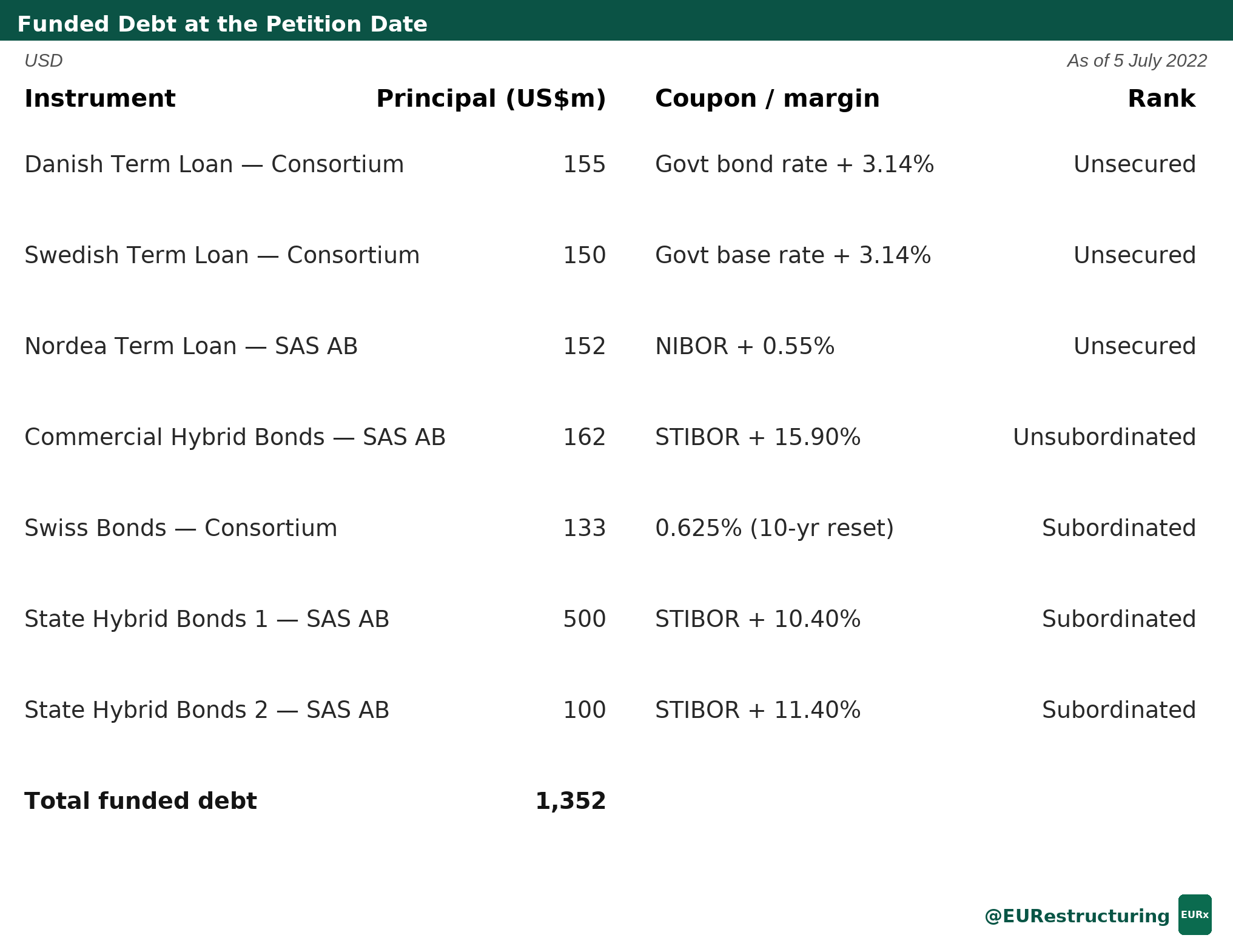
The debtors. SAS AB and 13 affiliated debtors, including the Consortium, SAS Norge, SAS Sverige, the North American subsidiary and seven Gorm leasing entities, filed voluntary chapter 11 petitions in the Southern District of New York on 5 July 2022. The cases are jointly administered under SAS AB, Case No. 22-10925 (MEW). Consolidated assets were approximately $12.43bn and liabilities approximately $9.41bn as of 31 May 2022. Funded debt of approximately $1.35bn in aggregate principal, all of it unsecured, sat alongside operating lease liabilities of approximately $1.53bn.
Case administration. Judge Michael E. Wiles. Debtors' advisors: Weil Gotshal & Manges (counsel), FTI Consulting (financial advisor), Seabury Securities and SEB (restructuring advisors), Kroll (claims and noticing agent). Board of eleven led by Carsten Dilling; Anko van der Werff, President and CEO. First-day hearing on the cash management and other first-day motions, held on 8 July 2022. DIP bid deadline set for 12 August 2022; final DIP hearing on 21 September 2022.
No committed DIP at the filing date. SAS filed without a committed DIP facility. Approximately $444m sat in the debtors' cash pool and approximately $365m in standalone accounts at the commencement date, enough to operate, not enough to fund a restructuring. Seabury and SEB solicited bids for approximately $700m of DIP financing from the same 90-plus sources approached for equity capital. Bids were due on 12 August 2022. Apollo Management Holdings, L.P. emerged as the winning bidder. Interest was priced at SOFR plus a margin, with fees and a 1% breakup fee approved in August 2022.
Industry precedent transactions. SAS filed into a market where the pandemic had already pushed the large Latin American carriers through the same court: Avianca, Aeromexico and LATAM Airlines Group all filed chapter 11 in 2020.
The SAS decision papers lean on two of them. Judge Wiles cited In re LATAM Airlines Group S.A., 620 B.R. 722 (Bankr. S.D.N.Y. 2020), where equity rights granted outside the plan process were refused as a sub rosa plan, and pointed to Grupo Aeromexico as the precedent for a DIP call option approved without objection and with committee support.
SAS was, however, the first flag carrier owned by European Union member states to use the US court. The case raised the question of what happens when the shareholders that must approve a capital raise are also the creditors wiped out inside the plan.
The DIP came with an option on the reorganized equity. The lenders were a group organized by Apollo Management Holdings, L.P. The facility was $700 million in two pieces. SAS could draw $350 million at once, and a second $350 million only if it hit savings targets under its cost reduction plan.
Two terms made it unusual.
A call option. Apollo could convert its DIP loans, or pay cash, to buy equity issued under the eventual plan. The equity bought would be the greater of the DIP balance at the effective date or $700 million plus accumulated interest and fees. The price assumed a total enterprise value of $3.2 billion, calculated under a schedule to the DIP agreement. The court's own example: if a plan were later filed on a $3.3 billion valuation, Apollo could still buy at $3.2 billion, “thereby effectively allowing Apollo to buy the equity at a discount.”
The creditors' committee negotiated one limit. The option would fall away if SAS failed to qualify for the second $350 million, or qualified and Apollo refused to lend it. If SAS qualified, the option vested whether or not SAS actually drew the money.
Tag rights. Apollo could buy up to 30% of the new money equity issued under the plan, on the same terms offered to third parties. These vested on approval of the DIP, regardless of how much was ever lent.
Both rights were terminable for a fee. Neither right was irrevocable, and that was the debtors' main argument. SAS could refuse to let Apollo exercise the call option by paying a termination fee: $19.52 million within the first twelve months, or after that whatever amount gave the lenders an all-in return of 23.2%. The tag rights could be terminated for $21 million, down from the $28 million originally proposed after the committee negotiated it lower.
The debtors said the option package had bought them about 3% in interest savings. At the August hearing, with the tag fee still at $28 million, the judge pointed out that the two termination fees together came to $47.52 million, or 6.79% of the DIP commitments. If both fees were ever paid, they would cost more than twice the claimed saving.
Wiles said plan terms belong to the plan process. The core of the decision is a statement about what section 363 of the Bankruptcy Code does not allow. The judge thought SAS's counsel had suggested, by analogy to the Supreme Court's 203 N. LaSalle decision, that the right to take part in a plan process is property a debtor can sell. He rejected that: (Doc. 376)
“I do not believe that Section 363 of the Bankruptcy Code contemplates that any of the elements of a future plan of reorganization, or the terms on which equity will be issued or sold under a future plan, can be determined in advance, or can be sold to willing buyers outside of a plan process, based solely on the suggestion that a debtor's management thinks that doing so would represent an exercise of sound business judgment.”
He went further. Had the option and tag rights been irrevocable, “then frankly I cannot imagine that I would have approved it.” He also disclosed that in earlier, unpublished cases where DIP lenders asked for a fixed percentage of reorganized equity, he had “flatly denied the proposed terms in each of those prior cases.”
He cited In re LATAM Airlines Group S.A., 620 B.R. 722 (Bankr. S.D.N.Y. 2020), where Judge Garrity refused equity rights granted outside the plan process as a sub rosa plan.
He approved it anyway, for three case-specific reasons. The decision is candid that the outcome turned on the procedural posture, not the principle.
- No one objected. The committee said it disliked the provisions “in the abstract” but supported the deal. The debtors had kept the process open for competing proposals and said none was better. Refusing would have meant ruling on points “that only I have thought it important to raise.”
- There was some precedent. The judge pointed to Grupo Aeromexico, Case No. 20-11563 (SCC), where similar terms were approved without objection and with committee support.
- His own earlier order. In August he had approved a 1% breakup fee and up to $1 million of expenses for the DIP. Looking back, he wrote, that order implicitly said there was no absolute bar to the terms, and it may have shaped the rest of the process. It would not be fair to reverse course at the final hearing.
He expressly saved “for another day” whether terminable equity options in a DIP are permissible where someone does object.
The court found the cost-benefit analysis unsupported. The second half of the decision reviews the debtors' cost and benefit analysis.
The claimed benefit of $19.5 million assumed the DIP stayed outstanding for a full year and that SAS qualified for the full $700 million by December 2022. The DIP's actual term was nine months, with extension options. The judge called $19.5 million the maximum benefit, not the expected one.
No one had valued the option. The judge noted that a Black-Scholes model could be adjusted for a cap such as the termination fee, but the debtors and the committee had not run one. He had no evidence at all on what the tag rights were worth, beyond the fact that Apollo “bargained very hard to get them.”
The debtors' comparison tables set maximum benefits against probability-weighted costs. One assumed Apollo had a 50% chance of winning the plan process, so only half the $21 million tag fee was counted. The judge called this “an 'apples to oranges' comparison.” The debtors' adviser accepted that comparing maximum benefit to maximum cost would show costs exceeding benefits in most scenarios. Other tables cut the tag cost to 25% by also assuming a rival bidder would happily let Apollo take 30% of its equity. Those percentages, the judge wrote, “seem to me to have simply been grabbed out of thin air,” selected “more for the purpose of trying to downplay the likely costs of the tag right termination fees.”
His concern was less about SAS than about the next case: “if we open a door by a crack in one case, the door gets pushed open ever wider in succeeding cases.” He asked where the line would be drawn for terminable options sold to insiders or to friendly bidders.
Apollo lost the plan process and was refinanced out. Apollo did not end up owning SAS. The winning bid came from a group led by Castlelake, chosen through the court-approved equity solicitation process. The confirmation order finds that it was “the highest and best offer” for the new shares and convertible notes. (Doc. 2347)
The documents show how Apollo was taken out:
- A replacement DIP. The plan defines the DIP facility as a new loan of up to $500 million dated 4 November 2023, with Wilmington Savings Fund Society as agent. The original $700 million facility was paid off under a payoff letter dated 15 November 2023. The investment agreement refers to Castlelake's expense rights under the replacement DIP agreement, which indicates that Castlelake or an affiliate lent into it.
- The tag fee. The investment agreement obliged SAS to seek court approval to terminate Apollo's tag right and pay the $21,000,000 tag right termination fee, and allowed SAS to fund it from the investors' escrowed deposit. Payment of that fee is also listed as a closing delivery.
- Loose ends with the old lenders. The order preserves a dispute mechanism for any advisors' fees under the original DIP that SAS had objected to, with a notice and court process if the original lenders still want paying.
The court record does not show whether the separate call option termination fee was paid.
The investors put in $1.2 billion and split the equity four ways. The plan provides for a total investment of $1,200,000,000: $475,000,000 for new shares and $725,000,000 of senior secured convertible notes.
Expected holdings after closing, before any conversion:
| Holder | New shares | Convertible notes |
|---|---|---|
| Castlelake | 32.0% | 55.2% |
| Danish state | 25.8% | 30.0% |
| Air France-KLM | 19.9% | 4.8% |
| Lind Invest | 8.6% | 10.0% |
| Certain creditors | 13.6% | 0.0% |
The convertible notes term sheet annexed to the investment agreement sets interest at Term SOFR plus 650 basis points, a seven-year maturity, a 1.50% original issue discount and a 3.025% upfront fee. Holders can put the notes at 110% on a change of control. Conversion value applies a premium that rises from 125% in fiscal 2024 to 160% in fiscal 2031, and the conversion price is set off an EBITDA multiple drawn from a weighted basket: Air France-KLM 30%, Lufthansa 30%, IAG 30% and Finnair 10%. Security includes the SAS brand, the EuroBonus trademarks and the shares in SAS EuroBonus AB, aircraft and engines, and SAS's own London Heathrow slots.
Unsecured creditors' recovery. Unsecured creditors share up to $325,000,000 of value through cash, new shares and interests in a separate creditor vehicle. The parts:
- Cash. The plan's own illustration puts immediately available cash at about $33,820,000 at an exchange rate of SEK 10.3538 per dollar on 2 February 2024.
- Shares. A pool of new shares worth about $75,000,000.
- A reserve against state claims. SEK 2,325,000,000 is held back in a Luxembourg vehicle that issues contingent value notes to unsecured creditors. The money exists to cover any “State Non-Tax Claim” for the period 2020 to 2023. The EU General Court annulled the Commission's approval of the 2020 state recapitalisation on 10 May 2023 (Case T-238/21). If no such claim is asserted, the reserve is released on 31 December 2033, or earlier on a final resolution, a third-party payment arrangement, or agreement between the company and the investors.
Two smaller terms apply. The pilot unions' allowed claim was capped at a recovery of SEK 100,000,000, with the excess redistributed to other creditors. Claims of $1,499,000 or less against the main operating debtors could take 10% in cash as a convenience class.
State-held classes deemed to reject. SAS described the plan as having the support of more than 99% of voting creditors. The order shows which classes actually voted.
Classes that accepted: aircraft lease and trade claims, and the commercial hybrid bond, other unsecured and intercompany claims, at SAS AB; aircraft lease, trade and union claims, other unsecured claims and convenience claims at the main operating debtors; aircraft lease claims at the Gorm aircraft entities; and other unsecured claims at the North American subsidiary.
Classes where nobody voted: the Norwegian term loan at SAS AB, the Danish, Swedish and Norwegian state term loans at the operating debtors, and other unsecured claims at the Gorm aircraft entities. The court held that a class with no votes is not an accepting class.
Classes deemed to reject because they received nothing: the Swiss bonds (about $133 million), the state hybrid bonds ($504.7 million) and the Danish state hybrid bond ($101.6 million), and the existing shares.
The court confirmed the plan over all of them under section 1129(b), finding no unfair discrimination and that no junior class received anything. The states' silence was deliberate. The plan, as modified by the order, records that Denmark, Sweden and Norway supported it but were not consenting to the court's jurisdiction or waiving sovereign immunity, so they did not vote. Their releases were given in separate agreements instead.
Two smaller disputes.
SEB's retention (17 October 2022). The US Trustee objected to Skandinaviska Enskilda Banken acting as co-investment banker alongside Seabury, arguing it was not disinterested. SEB had issued 42 guarantees of SAS obligations, mostly airport and ticketing charges, totalling about $10 million and fully cash collateralised, two of them (about $452,937) collateralised within 90 days of filing. The judge's concern was the bar on retaining a professional who is a “creditor.” SEB waived any prepetition claims for indemnity or reimbursement on the guarantees, the US Trustee was satisfied, and both retentions were approved. (Doc. 525)
Aircraft lessors and the Cape Town Convention (22 July 2024). CAVIC, lessor of two aircraft (MSN 1660 and MSN 9173), argued that Alternative A of the Cape Town aircraft protocol entitled it to full contractual rent during the waiting period as an administrative expense, rather than the reduced market-based payments in the stipulations agreed in November 2022. The court denied that request, and denied administrative treatment for a $5.5 million end-of-lease maintenance payment on MSN 9173, holding it was triggered by rejection and so was a prepetition unsecured claim under section 365(g)(1). The debtors accepted administrative claims of $375,000 and $435,000 for missed final stipulation payments. The judge cited the Australian Full Federal Court's VB Leaseco decision [2020] FCAFC 168 as reaching the same view on return conditions. (Doc. 2877)
Conditions to emergence. Confirmation was not the end. The plan could only go effective once a Swedish reorganization plan for SAS AB had been confirmed and become final, the existing shares had been cancelled and delisted, the European Commission had cleared both the 2020 recapitalisation and the new state aid, the EFTA Surveillance Authority had cleared Norway's contribution, and SAS's slot portfolio was substantially intact.
Those conditions took five months to clear. SAS announced on 28 August 2024 that it had completed both the US and the Swedish proceedings and emerged from chapter 11, with the USD 1.2 billion investment closed. The company said more than USD 2 billion of debt had been restructured, that distributions of cash, equity and contingent value notes to creditors would follow within the coming month, and that the new owners would appoint a board chaired by Kare Schultz.
SAS also said in March 2024 that it had agreed lease terms with 15 lessors covering 59 aircraft, worth at least SEK 1.0 billion a year in savings. The main cases were closed by order on 27 December 2024, except Gorm Warm Red Limited (Case No. 23-10935), with a final decree entered on 3 March 2026.
The Swiss perpetual notes. SAS Consortium, the vehicle behind a financing dating from the 1980s, issued CHF 127.2 million (about $152.9 million) of 40-year subordinated perpetual notes, listed in Zurich. The plan deemed the class to reject, and the holders received nothing.
On 5 November 2026, holders of more than half the notes sent SAS a letter saying the notes remain valid. Their argument is that Swiss law did not recognise the New York bankruptcy, so the discharge does not bind them. Interest on the notes has not been paid since January 2023. The letter says the holders are taking steps to enforce. (Bloomberg, November 2026)
Air France-KLM took about 20% after emergence, its first stake in 2024, and targets a controlling 60.5% in the first quarter of next year. An enforceable Swiss claim at the bottom of the stack is not a veto over that deal, but it is another claimant standing between the investors and a clean balance sheet.
What this case means for lenders. The decision is often cited as an approval of equity-linked DIP terms. The terms survived because they were terminable, unopposed, backed by the committee, and partly locked in by an earlier order. Strip out any one of those and the judge's own words suggest a different result.
Apollo's rights did not make it the owner. A rival group won the equity process, refinanced the DIP and wrote the $21 million tag fee into its own deal. For a lender, a terminable equity right in a DIP functions as a priced exit rather than a path to control.
For a creditor in a future case facing a DIP with a call option or tag rights, the decision gives a ready-made objection: it asks for a real option valuation, a like-for-like cost and benefit comparison, and an explanation of why plan terms are being set before there is a plan.
Follow @EURestructuring for daily coverage of European and Asian restructurings and distressed credit: the weekday distress report, filing alerts, live credit notes and full case studies. Subscribe at eurx.substack.com to receive each piece as it publishes.