Case Summaries · Oil & gas services
Petrofac's restructuring died on appeal. The group was sold in pieces anyway
Two Part 26A plans were sanctioned at first instance and then set aside on appeal, because the cross-class cram-down handed the assenting classes an inequitable share of the benefits. The operating businesses were sold piece by piece instead, the secured creditors have taken about US$60m so far, and the claims of Saipem, Samsung and Thai Oil sit at the empty top of the structure.
Key terms
- Company
- Petrofac Limited, a Jersey-incorporated energy services group working in engineering and construction, asset solutions (operations, maintenance and decommissioning) and integrated energy services
- Process
- two inter-conditional Part 26A restructuring plans, one for Petrofac Limited and one for its guarantor Petrofac International (UAE) LLC, announced with a Practice Statement Letter on 23 December 2024, sanctioned at first instance 20 May 2025, overturned by the Court of Appeal on 1 July 2025
- Debt
- about US$909m of senior secured funded debt; unsecured claims released under the plans estimated by the Court of Appeal at about US$3bn, of which more than US$1.6bn was assumed due to Thai Oil
- New money
- US$350m of new secured debt and equity for 67.7% of the remaining equity. The plan was never implemented
- The end
- TenneT terminated Petrofac's scope on the 2GW North Sea grid programme on 23 October 2025. Petrofac Limited entered administration on 28 October 2025, with James Bennett and Matthew Cowlishaw of Teneo as joint administrators; Petrofac International followed on 10 December 2025, and Petrofac Services and Petrofac Treasury UK on 11 December 2025, with David Soden joining for the two English companies
- Where it went
- Asset Solutions sold to CB&I, completed 9 April 2026. Petrofac Emirates, the core UAE engineering and construction business, sold to a consortium led by Mason Capital Management and Pearlstone Alternative, completed 26 May 2026
- Today
- the operating businesses sit with their new owners free of funded debt. The holding companies are in administration, and the claims of Saipem, Samsung and Thai Oil sit at the empty top of the structure
How we got here: an SFO case that turned into a balance sheet case
Petrofac built its business constructing and operating energy infrastructure across the Middle East and North Africa, and for most of its listed life its clients were the national oil companies of the region. From 2017 the Serious Fraud Office investigated the group for bribery and corruption. In October 2021 Petrofac Limited pleaded guilty to seven offences of failing to prevent bribery, and on 4 October 2021 Southwark Crown Court imposed a total penalty of £77m: a £22.8m confiscation order, a £47.2m fine and £7m of Serious Fraud Office costs. The investigation did not just cost money. It made Petrofac a difficult counterparty for exactly the customers that gave it its order book, and revenue followed.
Group revenue for 2023 came in at about US$2.5bn, and by the half year to 30 June 2024 the new-work engine had stalled: engineering and construction booked US$0.2bn of variation orders in the half, against US$3.4bn a year earlier, and its backlog thinned from US$6.1bn at the end of 2023 to US$5.7bn. Business performance EBITDA widened from a US$30m loss to US$66m, net debt rose to US$622m against US$164m of cash, and all US$798m of available borrowing facilities were drawn. The group stayed compliant with its minimum liquidity covenant throughout, but needed a waiver on the EBITDA covenant.
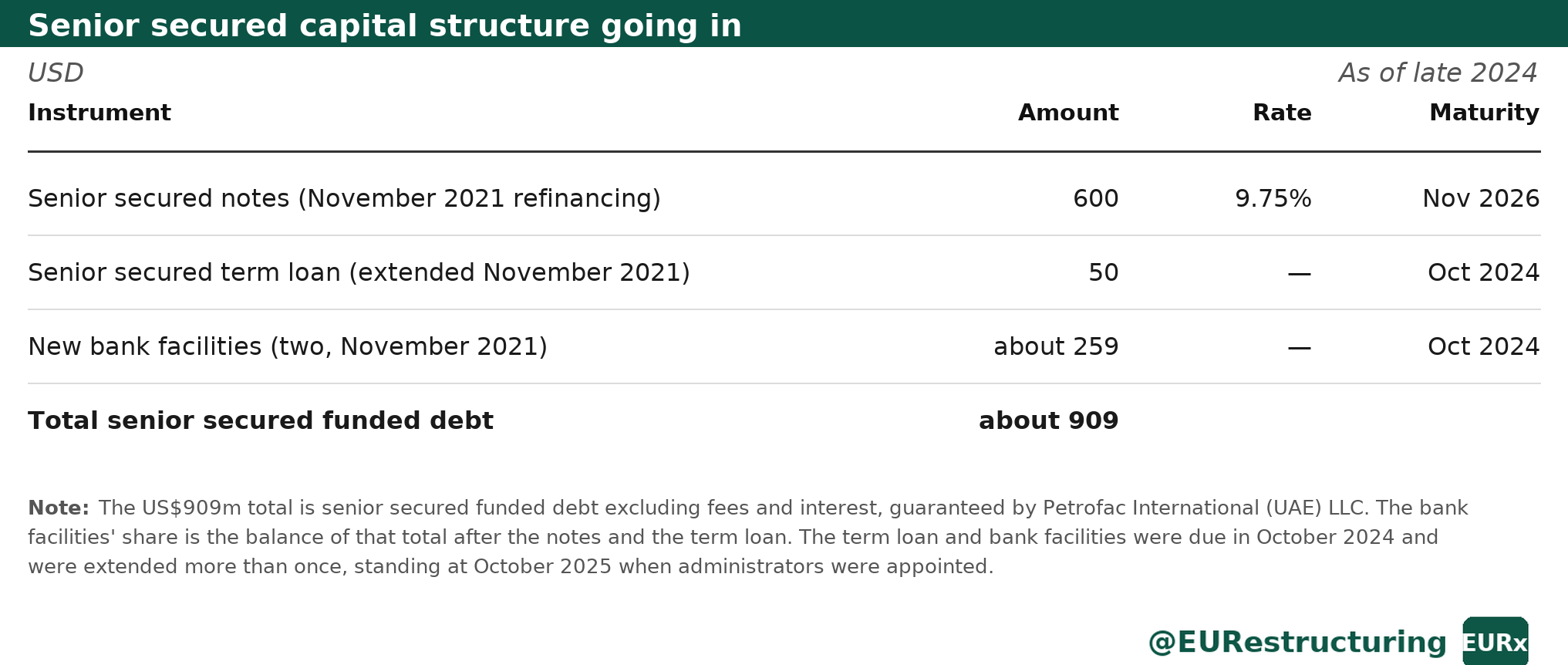
In November 2021, Petrofac announced a US$250m capital raise, US$600m of new senior secured notes, two new bank facilities and an extension of an existing US$50m senior secured term loan. That bought time but not solvency. The biggest single problem was the Clean Fuels Project in Thailand, where the customer is Thai Oil and the joint venture vehicle, PSS BV, sits alongside Saipem and Samsung. Saipem and Samsung served termination notices on Thai Oil on 23 April 2025 and arbitration is pending. The plans assumed the consortium's exposure to Thai Oil at about US$1.63bn; at first instance the court worked with a US$1.5bn split, on the evidence available, evenly between Saipem and Samsung.
Despite the extensive corporate governance review and compliance overhaul that followed the SFO case, the court later recorded that the group's business continued to suffer, exacerbated by the Covid pandemic and the war in Ukraine. The group still won material new work in the years that followed, including the ADNOC carbon dioxide capture contract and the TenneT framework agreement, but it struggled to obtain the performance bonds needed to begin those projects without posting cash collateral, which the administrators later attributed to the group's leverage and the perceived credit risk that came with it, and which placed a material strain on liquidity.
The Clean Fuels Project compounded all of it: heavily loss-making, with cost overruns the administrators put at more than US$1bn, on a fixed-price contract the consortium could no longer fund. By September 2023, the court found, it had become clear that the 2021 refinancing had not resulted in the long-term stabilisation of the group, and it began exploring options for alleviating its financial position.
The group held no significant property assets to pledge; its value sat in a small number of large, mostly fixed-price contracts with regional clients, and the company's own explanatory statement described the Clean Fuels exposure as an existential threat to the group's viability as a going concern. The valuation the court examined assumed management could secure the guarantee lines its ongoing and future contracts needed, and the customer concentration ran high, with ADNOC and TenneT together expected to account for about 70% of engineering and construction revenue over the forecast period. Through 2023 and 2024 the group managed rather than restructured: a liquidity monitor was appointed, the maturities of the revolving credit facility and the term loans were extended more than once, amortisation was deferred repeatedly and non-core assets were put up for sale, while negotiations with the ad hoc group of noteholders and the bank lenders on a holistic restructuring ran alongside one last attempt at a consensual settlement with the Thai Oil consortium, which ultimately was not possible.
By late 2024 the secured debt stack stood at about US$909m of senior secured funded debt, excluding fees and interest, guaranteed by PIUL and secured over the group. The company announced the restructuring and sent the Practice Statement Letter on 23 December 2024. By January 2025 more than 70% of bondholders had acceded to a lock-up agreement, and the consent solicitation to move the notes to English law had drawn about 85% support. Rating agencies had already said in January that the proposed restructuring constituted a distressed debt exchange, and by February Fitch noted liquidity was insufficient to cover the coming obligations. The timetable slipped: a convening hearing set for 25 February and a sanction hearing for late March became a sanction handed down on 20 May 2025.
Two plans, one cram-down
The structure will be familiar to US readers: a plan support arrangement signed months in advance, new money priced at a discount to the risk, and fees to the group that underwrites it, all before anyone votes. The English version ran through two Part 26A plans, one for Petrofac Limited and one for PIUL, which had to be sanctioned together or not at all. Seven classes met under the PL plan and five under the PIUL plan. In the senior secured class, 99 creditors holding 88.41% of claims by value attended and voted 100% in favour. The class holding Saipem's and Samsung's claims dissented, so sanction required the cross-class cram-down power in section 901G of the Companies Act 2006.
The new money was US$350m, in a mix of new secured debt and equity. US$187.5m of it was underwritten by senior secured creditors in return for Backstop Fees of about US$62.6m, of which roughly 80% went to the ad hoc group. US$226m came from providers with no existing exposure, including US$75m from two funds managed by Nut Tree Capital Management, which between them already held US$23.4m of existing debt. The ad hoc group, holding 31.3% of the senior secured debt by value, was separately paid a Work Fee of US$7.1m, fixed at 2.5% of its aggregate holding of senior secured funded debt rather than by reference to the work done or the time spent. As the Court of Appeal later recorded, the fee was agreed between the ad hoc group and the plan companies shortly before the Practice Statement Letter went out.
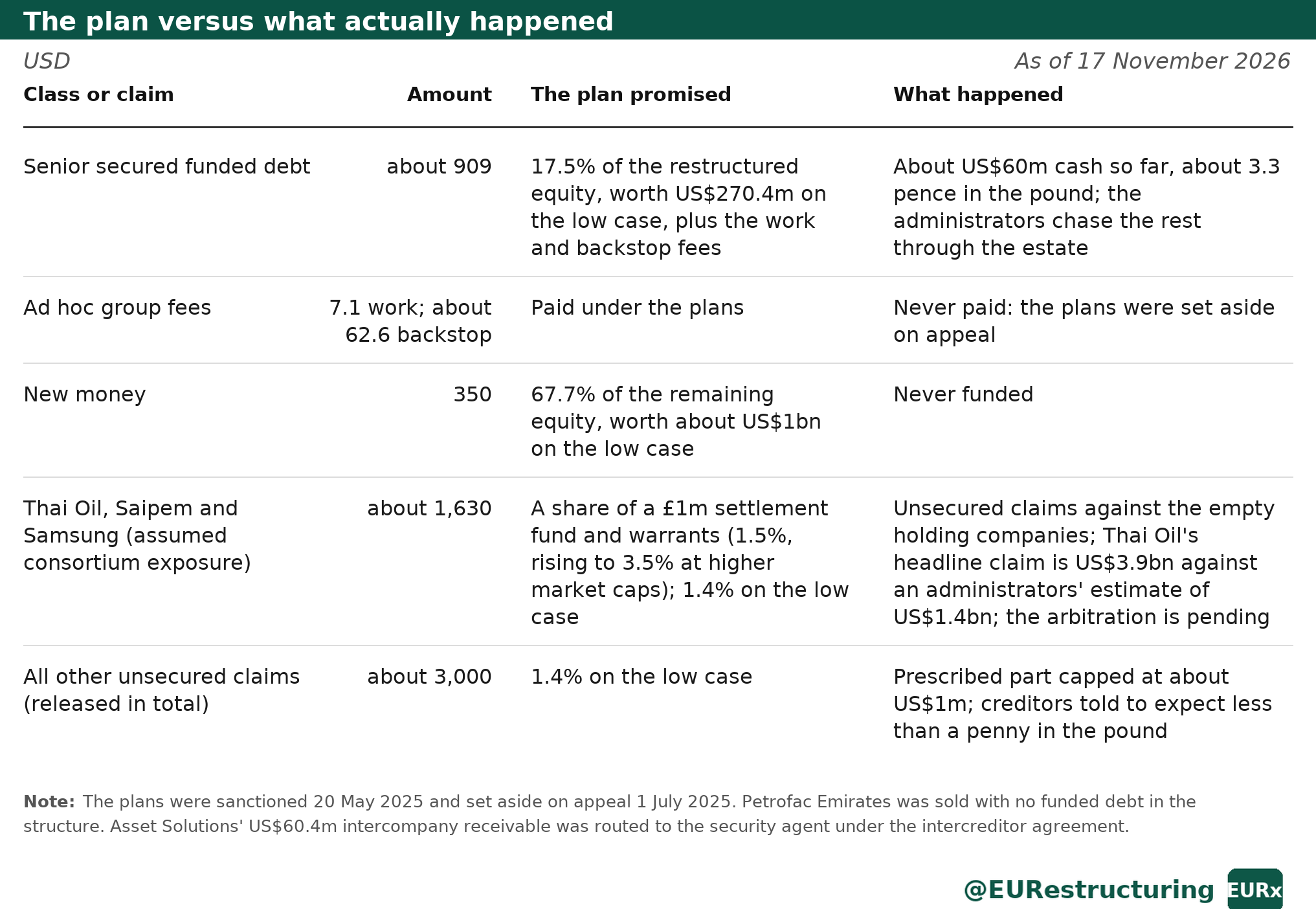
In exchange for writing off their claims, secured creditors were to receive about 17.5% of the post-restructuring equity. The new money providers took 67.7% of the remaining equity, worth about US$1bn on the low case. Out of the money unsecured creditors, Thai Oil, Saipem and Samsung among them, were offered a share of a £1m settlement fund and warrants over 1.5% of the post-restructuring equity if the market capitalisation exceeded US$1.35bn, with another 2% if it exceeded US$1.95bn.
The valuation the court worked with, agreed between the parties on appeal, put the day one post-restructuring equity at US$1.5bn to US$1.85bn. On the low case the returns looked like this: senior secured creditors and ABN Amro took equity worth US$270.4m; Samsung's claim against PIUL was valued at US$9.5m, a 10.2% return; Argonaut's at US$3m, 8.5%; shareholder claims at US$23m, 1.9%; and all other unsecured claims, Thai Oil, Saipem and Samsung included, at 1.4%.
The fight
Saipem and Samsung opposed on three fronts. They said the relevant alternative was not group-wide insolvency but a different restructuring in which they would do better; they said the Work Fee fractured the class, because members of the ad hoc group received it and their creditors did not; and they argued the plans handed an indirect economic benefit to competitors, since Saipem and Samsung would profit from a liquidation in which Petrofac's capacity disappeared. Their ask was specific: US$25m in cash by 31 December 2027 plus Tranche 1 warrants the company valued at US$36m to US$45m, a total of US$61.1m to US$69.5m, or 9.3% to 10.8% of the roughly US$1bn of value they said the plans assumed would be available. Samsung had also been offered, alongside Argonaut, the chance to provide up to US$25m of new money for a US$1.25m cash fee and a contingent value rights instrument worth US$9.8m.
The judge sanctioned both plans on 20 May 2025. On the indirect benefit argument he found the no worse off test was still satisfied. Saipem and Samsung appealed on two grounds, and won on the second.
The Court of Appeal: the benefits have to be shared fairly
The judgment of 1 July 2025, Saipem and others v Petrofac, is the third Court of Appeal decision on Part 26A, after Adler in 2024 and Thames Water earlier in 2025. The judge stated the cross-class cram-down power was introduced to stop a dissenting class exercising an unjustified veto, and it was not designed as a tool to enable assenting classes to appropriate to themselves an inequitable share of the benefits of the restructuring. The court found the evidence did not show the new money terms had been competitively tested, and that the write-off arithmetic told its own story: plan creditors' existing claims were exchanged for equity and cash valued on the low case at US$329m, against about US$900m of senior secured debt written off and about US$3bn of unsecured debt released, while US$350m of new money bought 67.7% of the equity worth about US$1bn.
The court allowed the appeal on that ground alone and set the sanction aside. It did not decide the indirect benefit point. For a few months the plans were alive again in theory: the company could have redone the allocation and come back for a second sanction hearing. It never got the chance.
TenneT ends the argument
On 23 October 2025 TenneT, the Dutch grid operator, terminated Petrofac's scope of work on the 2GW programme of offshore grid connections, a framework won with Hitachi in 2023 and, on secondary reporting, the source of a large share of the engineering and construction pipeline. The company said three days later that the restructuring was no longer practical in its current form, and that the directors of Petrofac Limited were applying to the High Court to appoint administrators, describing it as a targeted administration of the group's ultimate holding company only. The shares had been suspended since April 2025.
Petrofac International Limited, the Jersey-incorporated MENA entity, had no ongoing contracts and 120 staff, so on 25 November 2025 the company announced it would seek a letter of request from the Royal Court of Jersey under section 426 of the Insolvency Act 1986 so English administrators could be appointed over it. Petrofac Limited had been in administration since 28 October 2025, Bennett and Cowlishaw appointed by the High Court. Petrofac International's appointment came through on 10 December 2025, and Petrofac Services and Petrofac Treasury UK followed on 11 December 2025, with Soden joining for the two English companies.
The break-up
Asset Solutions, Petrofac’s North Sea operations, maintenance and decommissioning business with about 3,000 staff, was agreed to CB&I on 24 December 2025. The sale needed a company voluntary arrangement at Petrofac Facilities Management Limited, approved at a meeting on 30 January 2026 by 99% of creditors voting and 86% by value of claims. HM Revenue and Customs voted against the arrangement with a claim of about £151.8m, most of it disputed historical secondary national insurance contributions, and challenged it in February; the court rejected the challenge and HMRC confirmed it would not appeal. The sale completed on 9 April 2026. The administrators attributed an enterprise value of US$136.5m to the Asset Solutions transferred group; after adjustments the total payable came to US$79.6m, of which US$60.4m paid for the intercompany receivable the holding company held over the business, routed to the security agent under the intercreditor agreement. That produced the first distribution to the senior secured creditors, about US$60m, 3.3 pence in the pound on average, by April 2026. The purchaser also funded the CVA's compromised creditor fund: claims of £214.5m, HMRC's among them, were compromised at 1.98 pence in the pound, and the CVA was fully implemented on 31 July 2026.
Petrofac Emirates, the core UAE engineering and construction business, went next: an agreement announced on 17 March 2026 with a consortium of financial investors led by Mason Capital Management and Pearlstone Alternative, two of the group's existing lenders, completed on 26 May 2026 with no funded debt in the structure. The consideration was modest: about US$12.6m was made available to support the sale, of which about US$1.0m paid for the shareholding, the rest going to transaction costs and intercompany settlements, and the buyers injected fresh capital, released the bond over the business and took on end of service obligations for staff to keep ADNOC, its customer, on side. A separate sale of the Petrofac brand itself went with the deal for US$2.0m, US$1.4m net to the estate. The two sales connected at the top: the new board announced on 16 July 2026 is chaired by Michael Martino, the founder of Mason, who is also executive chair of CB&I Holding. Al Mazrui International invested in the holding company in August 2026. In June, Gulf News reported that former Petrofac staff in the UAE had received 70% of their unpaid dues after a six month wait, following pressure through the Ministry of Human Resources and Emiratisation.
What the plan would have paid, and what happened instead
Under the plans, the secured creditors would have written off about US$900m of senior secured debt and received about 17.5% of the equity of a restructured going concern worth, on the court's figures, US$1.5bn to US$1.85bn on day one, plus the fees. The new money would have arrived and funded the business. What actually happened is that the operating businesses were sold debt free to new owners, the senior secured creditors have taken about US$60m so far, 3.3 pence in the pound, with the chase now running through the remaining assets rather than a restructuring, and the value of everything else depends on what the administrators recover from there. The buyers were not the plan creditors: they are new money, and one of them chairs both the buyer of Asset Solutions and the owner of Petrofac Emirates.
For Saipem and Samsung, the appeal they won produced an odd result. The allocation they objected to was set aside, and the restructuring it belonged to then collapsed for reasons that had nothing to do with them. Their claims, and Thai Oil's, now sit against holding companies with no operating business inside them. Whether the appeal mattered to their recovery is the question the administrators' reports will answer.
What we are watching next
Petrofac International still holds six completed or nearly completed contracts in Kuwait, Oman and Qatar, where release of about US$400m of performance bonds depends on final acceptance certificates.
A settlement with Samsung on the two Kuwait and Oman joint ventures was signed in April 2026, instalments running into 2027, and tax clearances still being worked stand behind about US$19.6m of retentions from Qatar and about US$4.8m from Kuwait.
The two office towers the group owns outright in Sharjah are being readied for sale. Against the holding company, eleven unsecured claims totalling about US$4.2bn have been lodged, Thai Oil's headline claim of US$3.9bn among them, against an administrators' estimate of US$1.4bn; the fund set aside for unsecured creditors is capped at about US$1m and unsecured creditors are being told not to expect more than a penny in the pound.
The administrations have been extended into late 2027. The claims of Thai Oil, Saipem and Samsung against the empty holding companies, and whether any of it is settled in the arbitration, remain the live question. So does whether the Mason and CB&I ownership overlap draws any regulatory attention.
Two former Petrofac executives stand trial in London from Monday, charged over their part in directing about US$30m of corrupt payments to influence the award of contracts worth US$3.3bn in the UAE, the conduct behind the group's own SFO case. The trial had been set for October and slipped. Funding the defence was its own fight: nine Lloyd's insurers sued the two men to avoid covering it, arguing they had failed to disclose matters relating to the alleged offences under the group's directors and officers policy. In September the High Court held the policy had to fund the defence, and the Court of Appeal has now ruled the same way.
The settlement has since become a courtroom fight of its own. Under it Samsung took sole control of the DUQM refinery joint venture in Oman and the KNPC clean fuels joint venture in Kuwait, agreed to pay US$8m in three instalments for the handover and paid the first US$4.5m in May 2026. It then withheld the second, US$2.25m, saying PIL had not delivered the tax records it needs to file in the two countries, where a new Kuwaiti minimum top-up tax return is due by 31 March 2027 and Oman's filings by 30 April 2027.
PIL says it handed over roughly 28,500 emails and access to its document systems, that the contract bars withholding on these payments and that it suspended performance when the money did not come. It is suing for the US$2.25m and a Kuwaiti tax collection of KWD1.53m. Samsung wants the tax handover compelled now, with £500,000 parked with its lawyers as security for the injunction it would seek if the two sides cannot agree.
PIL has volunteered the materials by mid-January and says Samsung could have them sooner simply by paying the disputed sums under protest, which it refuses to do; it wants the money dispute decided first, by summary judgment. The applications were heard in the Commercial Court on 20 November. The retentions in Qatar and Kuwait and the DUQM acceptance certificates sit downstream of how this lands.
Sources
- 1. Petrofac Limited and Petrofac International (UAE) LLC, restructuring plans, sanction judgment, Marcus Smith J, [2025] EWHC 1250 (Ch), 20 May 2025: www.judiciary.uk/wp-content/uploads/2025/05/Petrofac-ju...
- 2. Saipem and others v Petrofac, Court of Appeal, Snowden LJ, Zacaroli LJ and Sir Christopher Floyd, [2025] EWCA Civ 821, 1 July 2025: www.judiciary.uk/wp-content/uploads/2025/07/Saipem-and-...
- 3. Petrofac, restructuring update, 27 October 2025: www.petrofac.com/media/news/restructuring-update-27-oct...
- 4. Petrofac, restructuring update, 25 November 2025: www.petrofac.com/media/news/restructuring-update-25-nov...
- 5. The Gazette, notice of administration appointment, Petrofac Treasury UK Limited, 16 December 2025: www.thegazette.co.uk/notice/5018972
- 6. Petrofac, update on financial restructuring, January 2025: www.petrofac.com/media/news/update-on-financial-restruc...
- 7. Fitch Ratings, Petrofac's proposed restructuring constitutes a distressed debt exchange, 13 January 2025: www.fitchratings.com/research/corporate-finance/petrofa...
- 8. Fitch Ratings, Petrofac Limited, 16 February 2025: www.fitchratings.com/research/corporate-finance/petrofa...
- 9. Fitch Ratings, Fitch affirms Petrofac Limited at 'Restricted Default', 11 June 2025: www.fitchratings.com/research/corporate-finance/fitch-a...
- 10. Petrofac, Petrofac Asset Solutions acquired by CB&I, 24 December 2025: www.petrofac.com/media/news/petrofac-asset-solutions-ac...
- 11. Petrofac, sale of Petrofac Asset Solutions to CB&I: company voluntary arrangement, January 2026: www.petrofac.com/media/news/sale-of-petrofac-asset-solu...
- 12. Petrofac, sale of Petrofac Asset Solutions to CB&I: CVA upheld, 12 March 2026: www.petrofac.com/media/news/sale-of-petrofac-asset-solu...
- 13. Petrofac, sale of Petrofac Asset Solutions to CB&I completes, 9 April 2026: www.petrofac.com/media/news/sale-of-petrofac-asset-solu...
- 14. Petrofac, Petrofac Emirates acquired by Mason Capital Management-led consortium, 17 March 2026: www.petrofac.com/media/news/petrofac-emirates-acquired-...
- 15. Petrofac, completion of sale of Petrofac Emirates, 26 May 2026: www.petrofac.com/media/news/completion-of-sale-of-petro...
- 16. Petrofac, new board of directors, 16 July 2026: www.petrofac.com/media/news/petrofac-announces-new-boar...
- 17. Petrofac, Al Mazrui becomes strategic investor in Petrofac, 6 August 2026: www.petrofac.com/media/news/al-mazrui-becomes-strategic...
- 18. Rigzone, Petrofac Emirates sold to Mason-led consortium, 27 May 2026: www.rigzone.com/news/petrofac_emirates_sold_to_masonled...
- 19. Gulf News, Petrofac UAE staff receive 70% of outstanding dues after six month wait, 22 June 2026: gulfnews.com/business/energy/petrofac-uae-staff-get-70-...
- 20. Energy Voice, CB&I completes Petrofac UK business takeover, 10 April 2026: www.energyvoice.com/markets/energy-finance/595568/cbi-c...
- 21. Teneo Financial Advisory, Joint Administrators' Statement of Proposals, Petrofac Limited, 11 December 2025, filed at Companies House: find-and-update.company-information.service.gov.uk/comp...
- 22. Teneo Financial Advisory, Joint Administrators' progress report, Petrofac Limited, 22 May 2026, filed at Companies House: find-and-update.company-information.service.gov.uk/comp...
- 23. Teneo Financial Advisory, Joint Administrators' progress report, Petrofac International Limited, Petrofac Services Limited and Petrofac Treasury UK Limited, 7 July 2026, filed at Companies House: find-and-update.company-information.service.gov.uk/comp...
- 24. Teneo Financial Advisory, Nominees' report on the meeting of creditors, Petrofac Facilities Management Limited CVA, 30 January 2026, filed at Companies House: find-and-update.company-information.service.gov.uk/comp...
- 25. Teneo Financial Advisory, Joint Supervisors' final report, Petrofac Facilities Management Limited CVA, 14 August 2026, filed at Companies House: find-and-update.company-information.service.gov.uk/comp...
- 26. Companies House, notice of extension of the period of administration, Petrofac Limited, 4 November 2026: find-and-update.company-information.service.gov.uk/comp...
- 27. Petrofac, statement on final outcome of SFO investigation, 4 October 2021: www.petrofac.com/media/news/statement-on-final-outcome-...
- 28. Law360 UK, Ex-Petrofac executives face trial over $30m UAE bribery, 20 November 2026: www.law360.com/corporate-crime-uk/articles/2552760
- 29. Law360, Insurers sue ex-Petrofac execs linked to bribery scandal, 11 August 2026: www.law360.com/articles/2511648/insurers-sue-ex-petrofa...
- 30. Law360 UK, Petrofac ruling clarifies D&O obligations amid fraud claims, 17 November 2026: www.law360.com/articles/2544594/petrofac-ruling-clarifi...
- 31. Samsung E&A Co Ltd, skeleton argument, Samsung E&A Co Ltd v Petrofac International Limited (in administration) and others, CL-2026-000602 (Comm), 19 November 2026, on file
- 32. Petrofac International Limited and others, defendants' skeleton argument for the same hearing, CL-2026-000602 (Comm), 19 November 2026, on file