Case Summaries · Healthcare real estate
Medical Properties Trust went to war with its lessees, short sellers and bondholders
Medical Properties Trust spent two decades borrowing to buy hospitals, then lending to the operators inside them, and the concentration that strategy produced caught up with it. Steward, the tenant that reached 42% of revenue by 2019, filed chapter 11 in May 2024, and Prospect followed in January 2025.
The company has spent the two years since fighting on two fronts: running a capital-structure repair past the unsecured bondholders whose paper absorbed the cost and chasing the money its failed tenants owe. Could another priming of the long end bonds be next?
Key terms
- Company
- Medical Properties Trust, Inc. (NYSE: MPT), a self-advised hospital real estate investment trust formed in 2003 and based in Birmingham, Alabama. Equity market cap of about $1.07bn at the 6 November close.
- Process
- Out of court. A private placement of new money alongside a private exchange of existing unsecured notes, agreed with institutional investors and closed on 10 August 2026.
- The instrument
- $2.4bn of 9.25% senior secured notes due 15 February 2032, issued by MPT Operating Partnership LP and MPT Finance Corporation, guaranteed by the company and secured by first-priority liens on the equity of the first-lien guarantor subsidiaries and mortgages on their real estate.
- New money
- About $1bn of cash proceeds redeemed the 0.993% notes due 2026 in full and about 27% of the 5.000% notes due 2027.
- Exchange
- About $1.5bn of senior unsecured notes due 2027, 2028, 2029, 2030 and 2031 exchanged into the new secured notes, capturing a discount of about $123m net of lender fees.
- Use of proceeds
- Full redemption of the €500m 0.993% senior unsecured notes due October 2026 and a partial redemption of the 5.000% notes due 2027.
- Call protection
- Make-whole redemption before 10 August 2028, then a declining premium. Up to 40% of the notes redeemable at 109.25 before August 2028 using equity-offering proceeds.
- Security
- First-priority liens on the equity of the first-lien guarantor subsidiaries and mortgages on their real estate, subject to foreign collateral limitations; on any refinancing of the revolver and the existing secured notes, second-priority liens on that collateral.
- Covenants
- Limits on debt, liens, dividends, investments, affiliate transactions, mergers and asset transfers. Unencumbered assets must equal at least 150% of unsecured indebtedness under the unsecured indentures.
- Today
- Total debt of $9.37bn at 30 September 2026, $9.26bn of it net after issuance costs and discounts, per the third-quarter supplemental. Adjusted net debt of $8.13bn against adjusted annualised EBITDAre¹ of $938m gives 8.7x.

How we got here: the landlord became the lender of last resort
Medical Properties Trust was formed in August 2003 in Birmingham, Alabama by Edward Aldag, with co-founders Emmett McLean and Steve Hamner. It listed on the New York Stock Exchange on 7 July 2005 at $10.50 a share, valuing the company at about $400m. The founding premise was that hospital buildings were an unserved corner of the REIT market: office towers, warehouses, apartments and senior housing all had dedicated landlords, but the properties where the most acute care in medicine is delivered did not, because a hospital is a difficult building to re-let if its operator fails. MPT grew by acquiring existing hospital real estate portfolios from operators and their private-equity owners, chiefly through sale-leasebacks, with loans and equity stakes layered on top. The first portfolio was six post-acute and rehabilitation properties bought from Vibra Healthcare, which gave the trust a presence in six states from the outset. By 2008 its investments had grown by nearly 75% to more than $1.3bn with revenue above $100m, and it came through the financial crisis without a restructuring of its own. In 2011 the operating partnership issued its first unsecured bond, $450m of 6.875% senior notes due 2021.
How the structure formed
In connection with the Vibra acquisition, MPT's taxable REIT subsidiary lent the operator about $41m to buy the operations, secured by pledges of the operator's equity.² The leases and the loan were cross-defaulted, meaning a missed payment at one facility could put an operator's entire estate in default.³ MPT took equity in the operators alongside its lending commitments: a $100m investment in Ernest Health in 2012 alongside a $300m, 16-property real estate portfolio, then stakes in Steward and Prospect as those deals grew. MPT's loans to its operators continued to grow, as did total debt, from $3.35bn at the end of 2015 to a peak of about $11.4bn at the end of 2021, and about $10.5bn at 31 March 2023.
The private equity years
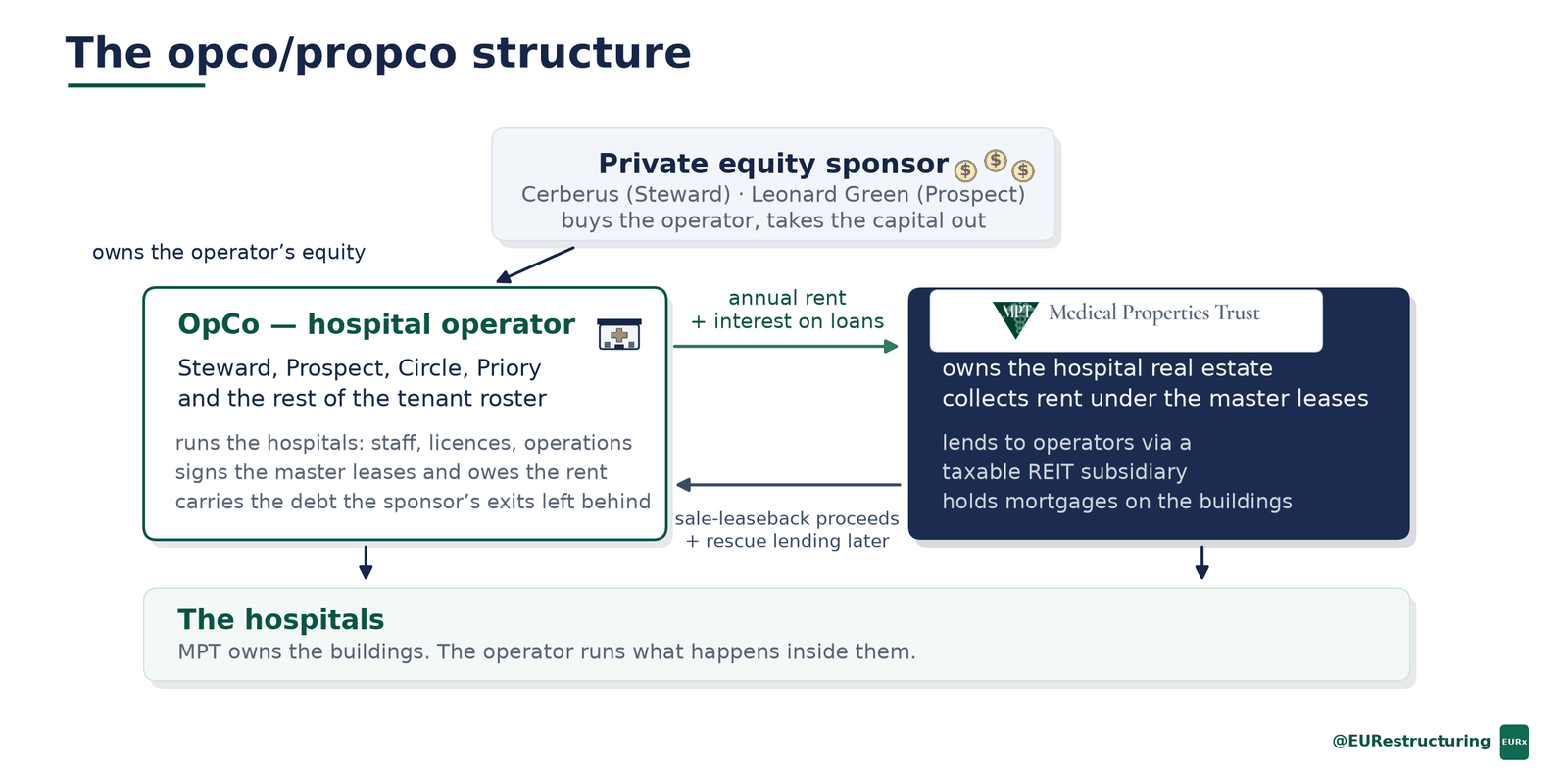
The roll-up is one of private equity's most tried-and-tested playbooks: buy a platform operator in a fragmented market (in this case hospital operators), fold smaller systems into it, centralise the back office and support functions (billing, group purchasing and administration) under one experienced management team, and take the resulting cost savings as value. Fund the acquisitions with debt to juice the returns. MPT added its own twist: sale-leasebacks with its tenants, which pulled capital out of the real estate while the operator kept running the hospitals.
MPT was a major beneficiary of the roll-up trade in 2010 via an “opco/propco” structure. A fund would buy or assemble a hospital operator: MPT would fund the real estate through a sale-leaseback and often lend on top; the fund would recover its capital, and MPT would hold the buildings with a newly leveraged tenant inside them. The archetype was Steward. In November 2010 Cerberus Capital Management bought Caritas Christi, six struggling nonprofit Catholic hospitals in Massachusetts, out of the Archdiocese of Boston for $246m, assuming $275m of debt and $200m of pension liabilities, $475m in total, in an $895m transaction, and rebranded the system Steward Health Care. In its first years as a for-profit system Steward did its first sale-leasebacks with MPT, beginning with medical office buildings. The deals grew from there: $900m for Capella Healthcare from GTCR in 2015, at that point the largest transaction in MPT's history, with Apollo Global Management buying the Capella operating company for $390m the following year and MPT keeping the real estate; and large deals with Steward and Prospect (more on those tenants below).
MPT then expanded its ambitions abroad. It bought eleven German rehabilitation hospitals from RHM Klinik in 2013 for about $245m, funded with a €200m bond; added Circle Bath, its first UK asset, and an agreement for forty MEDIAN Kliniken hospitals in 2014; entered Italy through Policlinico di Monza in 2015; put seventy-one German post-acute hospitals into a joint venture with Primonial valued at about $1.8bn in 2018; bought eleven Australian hospitals from Healthscope for $859m and a 46% interest in the $900m Swiss portfolio of Infracore in 2019, the year a first Portuguese asset took the count to eight countries; thirty UK hospitals from BMI Healthcare for about $2bn in 2020; thirty-five Priory behavioural health facilities for £800m in 2021; and a 2022 joint venture with Macquarie Asset Management covering eight Massachusetts hospitals valued at about $1.7bn.
The concentration those deals produced is what caught up with the company: Steward alone reached 42% of revenue by 2019, and both tenants at the centre of the model, Steward and Prospect, ended up in chapter 11. Neither failure was sudden. The roll-up model required each tenant to carry three charges at once: (1) rent set by the sale-leasebacks and escalating annually, (2) interest on the loans MPT layered on top, and (3) the debt the private-equity exits left behind, and none of the three adjusted when patient volumes or reimbursement did not keep up. The arithmetic was unforgiving: rent and interest were fixed obligations that escalated on schedule, while the operators' margins sat at the mercy of public-payor reimbursement, post-pandemic labour costs and patient volumes that never fully recovered. Steward's Massachusetts hospitals served largely older and low-income patients on Medicare and Medicaid; Prospect's weakest book, the four Crozer hospitals outside Philadelphia, had been losing money since the pandemic. Steward's one profitable year of the recent past was 2015; Steward's net worth was negative $1.5bn by 2020 and by 2023 it was skipping its rent outright. Prospect never fully covered its rent either. Its rent had been set off the $1.55bn purchase price rather than market rates on hospitals still carrying the 2018 recap's debt, and the business never grew into the schedule: trailing EBITDARM⁴ rent coverage went negative 0.5x by year-end 2022 against 2.3x for the portfolio overall, with the weakest link the four-hospital Crozer system outside Philadelphia that it had been trying to sell since 2022.
Steward
Steward's predecessor, Caritas Christi, was formed in 1985 as the umbrella for six hospitals of the Archdiocese of Boston. It had spent years in financial distress before Cerberus bought the system out in November 2010 and rebranded it Steward Health Care, keeping its chief executive, the cardiac surgeon Ralph de la Torre, as founder, chairman and chief executive. By mid-2016 Steward was the largest for-profit health care provider in Massachusetts and one of the state's largest private employers, with more than 17,000 employees and an estimated $2.3bn of revenue, running hospitals alongside a physician group of 152 sites and a network of some 3,000 physicians. Steward posted an operating profit of $131m on $2.2bn of revenue in 2015, its first profitable stretch after losing money in each of 2011, 2012 and 2013, $59m, $33m and $52m respectively, while debt rose from $326m to $413m over the same period.
In October 2016 MPT acquired Steward's real estate for $1.25bn ($600m of real estate, $600m of mortgage loans and $50m of equity) on 15-year initial leases with three five-year renewal options, with a promissory note in three tranches, maturing December 2023, December 2024 and October 2031, running alongside the master lease and the mortgages. MPT committed to participate in up to the next $1bn of Steward's hospital acquisitions, which is where the national growth, and the repeat sale-leasebacks, began. In 2017 MPT bought the IASIS hospital real estate for another $1.4bn and made about $700m of additional mortgage loans to Steward. Steward went from 10% of revenue in 2016 to 27% in 2017, 39% in 2018 and 42% in 2019.
In June 2020, Steward's physicians and management bought back the controlling stake from Cerberus Capital Management, ending its decade as the system's sponsor, with Cerberus taking a $350m promissory note rather than cash for its equity. MPT helped finance the exit, lending Steward's affiliates $335m, the proceeds of which retired that note at a $15m discount and handed MPT a 9.9% equity stake in Steward.
The rescue lending
Steward's financial health had been deteriorating for years, and the drivers compounded: the 2010 buyout had left the system carrying $475m of new debt and pension liabilities, every sale-leaseback raise had lifted the rent it owed its landlord, and the 2016 transaction layered $1.25bn of real-estate leverage onto a business generating $131m of operating profit. After 2015, Steward stopped filing complete audited accounts with Massachusetts regulators altogether, litigating against the reporting requirements while racking up fines (and losses). Its last available audited report, for 2020, showed it owing MPT $385.2m of annual rent on 35 hospitals, projected to reach $423m by 2024. Pandemic losses the system never recovered from sat on top of that: a rent burden built by serial sale-leasebacks, the $111m dividend paid to its owners in January 2021 and a $1.1bn expansion into Miami-Dade and southern Broward counties, five hospitals bought from Tenet Healthcare the same year. Cerberus had favoured a bankruptcy in 2020 that management refused, which postponed the reckoning rather than avoiding it.
Steward likely burned more than $1bn of cash between 2017 and 2021 simply paying the rent it owed MPT, and by 2023 it was dangerously low on cash. Its vendors sued en masse over unpaid bills, and by the autumn of 2023 it was skipping rent payments to MPT. At 31 December 2023 MPT moved every Steward lease and loan to cash accounting, reserved all unpaid rent and interest, reversed the straight-line rent it had recognised and booked roughly $700m of impairment and other charges for the year. From 2023 the rent stopped and every fix was MPT lending its own tenant: rent deferrals, roughly $215m of loans by early 2024, partly secured by a second lien on Steward’s managed-care platform, and a $60m bridge to Steward’s asset-based lenders in February 2024. The secured group around Steward carried its own paper: a $600m first-in, last-out (FILO) facility arranged in August 2023 and a further $150m bridge loan in February 2024, part of it from lenders who pulled back when the case arrived. Neither is MPT's own borrowing: they are Steward's debts, and MPT's share of the lending sits on the asset side of its balance sheet rather than in its capital stack.
The chapter 11
On 4 January 2024, with rent unpaid in full, MPT announced a $60m bridge loan to carry Steward's near-term obligations, secured on MPT's existing collateral plus new second liens on Steward's managed-care business that sat behind only the asset-based lenders, with a portion of MPT's existing loans covered by the same liens. In February MPT went further, funding a larger bridge alongside Steward's asset-backed creditors, each side putting in $75m of additional loans. Partial cash rent resumed, but the facilities carried no long-term fix, and by spring Steward was living bridge to bridge.
Steward eventually filed for chapter 11 on 6 May 2024 in the Southern District of Texas. It listed 31 hospitals in ten states, roughly 30,000 employees and more than two million patients a year, against $9.2bn of liabilities. MPT was the only debtor-in-possession financier at the petition date, committing $75m with a stated willingness to provide up to $225m more if asset sales succeeded. Days before the filing, on the first-quarter call, Edward Aldag would not commit beyond the initial $75m, after MPT booked a $736m quarterly loss on $693m of impairments, of which about $470m fully reserved the remaining 9.9% equity in Steward, the $362m loan to Steward's affiliates and the accrued property taxes Steward had not paid, against Steward exposure that still carried a $2.4bn master lease over 28 hospitals, roughly $346m of working capital and other secured loans and a $406m joint-venture investment.
The Department of Justice objected that the proposed milestones would interfere with its antitrust review of the sale of Stewardship Health, the physician and managed-care business, and the court added fee incentives, up to $6.75m for outside lenders plus $750,000 of expense reimbursement, to widen the field. None came. MPT declined to fund more, and three days before Steward’s cash ran out the case took a $225m FILO DIP from Steward’s existing secured lenders, Sound Point Capital, Brigade and Chamberlain among them, approved in mid-June 2024.
The lawsuit and the auction
On 19 August 2024 Steward sued MPT in a 24-page adversary proceeding, alleging that the landlord was blocking hospital sales to protect its own claims. Thirty of Steward's thirty-one hospitals sat under MPT master leases, and in what Steward called virtually every attempted sale the two sides had disputed how value split between the operating business and the real estate, leaving otherwise viable sales unable to proceed. The complaint also alleged MPT had approached prospective bidders directly, without Steward's consent, in violation of the court's sale-process order, and asked Judge Lopez to determine how sale proceeds should be allocated between the operations and the real estate. MPT answered that the Bankruptcy Act does not authorise a debtor to distribute other people's property among its creditors, and flagged that Steward's creditors were preparing a separate challenge to whether MPT actually owned the underlying real property. Eleven days later Steward, MPT, the FILO lenders and the creditors' committee announced an agreement in principle: MPT would fund the cost of running the master-lease hospitals, the hospitals would move to new interim operators, and Steward would retain the proceeds of the Florida sales to pay lenders and creditors. Orlando Health, a nonprofit health system based in Orlando, Florida, put in a $439.42m cash bid for the three Space Coast hospitals and their attached physician practices, designated the stalking horse in mid-August, drew no competing bids, and the sale was approved on 10 September.
On 11 September the court approved the settlement's interim steps: fifteen hospitals moved to four interim operators, Healthcare Systems of America, an operator affiliated with California-based American Healthcare Systems, taking more than half, including the five South Florida hospitals. MPT took control of its real estate under new leases carrying roughly $160m of annualised cash rent, with a weighted average initial term of about 18 years and minimum annual escalators, agreed to lend the new operators up to about $80m secured by receivables, repayable from asset-backed working capital facilities they were to complete with third-party lenders, took no cash rent for the remainder of 2024 and put $5m in escrow to cover transition costs. Healthcare Systems of America took its eight hospitals on a 20-year master lease running to September 2044, with three five-year options.
The definitive settlement followed on 17 September: Master Lease I, the amended and restated master lease signed in August 2021 that covered 28 Steward facilities and most of MPT's $2.8bn of Steward exposure at mid-2024, was deemed terminated, about $7.5bn of lease obligations were released against $395m of Florida sale proceeds, and the parties exchanged mutual releases, Steward waiving its claims against its landlord. Through the autumn the interim operators turned into buyers: Healthcare Systems of America took seven hospitals by purchase, Quorum Health bought Odessa Regional, HonorHealth took the Arizona hospitals, Christus Health bought Wadley in Texarkana, and Stewardship Health was sold to Rural Healthcare Group. Massachusetts ran its own negotiation inside the auction. The MPT-Macquarie joint venture, the 2022 partnership with Macquarie Asset Management that put eight Massachusetts hospitals into a vehicle valued at about $1.7bn, held the real estate of most of the state's Steward hospitals, and where no deal could be struck the government stepped in: Governor Maura Healey of Massachusetts took St. Elizabeth's Medical Center in Brighton by eminent domain in September 2024, after Apollo, the mortgage lender on the joint venture's properties, rejected Boston Medical Center's bid. Apollo sued, and the fight settled in July 2025 at a $66m purchase price, nearly fifteen times the state's opening offer. The other Massachusetts sales closed at prices reported as a loss, with most of the proceeds going to the real estate owners.
The claims that outlived the case
The unsecured creditors' committee had already flagged more than $1bn of what Steward owed MPT as possibly fraudulent or preferential transfers⁵, and called MPT's pre- and post-petition lending disguised financing. The joint plan of liquidation was filed on 28 April 2025; the United States Trustee moved to convert the case to chapter 7 over roughly $127m of unpaid administrative claims; and after a three-day confirmation hearing and more than 50 objections, Judge Lopez confirmed the plan as a liquidation on 25 July 2025 and denied the conversion motions.
On 15 July 2025 Steward sued its former chief executive, Ralph de la Torre, other former executives and Tenet Healthcare, which the complaint says was paid more than $200m over value for five Florida hospitals Steward bought for $1.1bn in 2021. On 15 and 16 July 2025 the debtors opened their own avoidance campaign, filing 151 adversary complaints against vendors and other counterparties, seeking to recover preferences and fraudulent transfers. The claims moved to the SHC Creditor Litigation Trust under trustee Mark Kronfeld, formally substituted as named plaintiff in the avoidance actions by an order signed on 15 September 2025, and its amended complaint of 21 November 2025 seeks more than $3.4bn. The trust alleges that the October 2016 dividend of roughly $790m, funded by the proceeds of the MPT sale-leaseback, left Steward insolvent, and puts Cerberus affiliates' aggregate distributions at about $719m and de la Torre's own at $38.3m from 2016 plus $81.5m of a $111m dividend paid in January 2021. In July 2026 Cerberus settled with the litigation trust for an amount the court file still keeps redacted; the approval motion was filed on 24 July and the order came on 30 July, precluding any stay of its effectiveness.
Sale-order enforcement ran on long after the closings. The buyers, their vendors and the plan and litigation trusts spent 2025 and 2026 trading motions to compel, contempt claims and objections over the sale orders, most of which ended in settlement or withdrawal, alongside a mediation of the main trust parties before Judge Michelle Harner. On 2 October 2026 Judge Lopez denied a Humana motion to enforce a sale order, which Humana appealed on 15 October. De la Torre subpoenaed Medical Properties Trust itself for documents in January 2026.
Prospect
Prospect's path to MPT also ran through private equity. A group of California physicians founded the company in 1996, and it grew from managing physician networks into owning and operating hospitals from 2007. Leonard Green & Partners took a 61.3% stake in 2010 in a $363m leveraged buyout, and the decade that followed was one of expansion and extraction in equal measure: Texas in 2012, a joint venture in Rhode Island in 2013, hospitals in New Jersey, Pennsylvania and Connecticut in 2016, funded in part by a $1.31bn dividend recapitalisation in 2018 that left Leonard Green with $658.4m of dividends and management fees over the course of its ownership.
By 2019 Prospect ran hospitals in California, Connecticut and Pennsylvania with roughly $3bn of annual revenue, and the July 2019 transaction was the first between the company and MPT: the trust announced Prospect as one of its two new operators, putting $1.55bn into the real estate interests of fourteen acute care hospitals and two behavioural facilities under two 15-year master leases ending in April 2034, including a $113m three-year term loan to be cancelled against the real estate of two of the hospitals, the leases, a mortgage loan and the term loan all cross-defaulted and cross-collateralised, with up to a further $250m of purchase-price adjustment available on performance targets. Rent was set off the $1.55bn price rather than market rates, at about 7.5% and escalating annually, a first-year rent of $116m, and MPT also took a 49% interest in PHP Holdings, the holding company around Prospect's managed-care and provider businesses. Prospect used the proceeds to pay down the debt the 2018 recap had left behind.
Prospect stayed current until the end of 2022, when rent and interest went past due. The deterioration ran mainly through its Pennsylvania hospitals: Crozer Health, the four-hospital suburban Philadelphia system, had been a financial drain since the pandemic, and Prospect had been trying to sell it since 2022, a definitive sale agreement with ChristianaCare signed that February having fallen apart by August, before Prospect moved in September to close Delaware County Memorial Hospital and lay off 334 workers, drawing suits from the Pennsylvania attorney general and the Foundation for Delaware County. With the sale-leaseback rent from the 2019 deal still escalating on top, MPT booked a $283m impairment charge in the December quarter: a $171m cut to the carrying value of the Pennsylvania real estate and a reserve against $112m of non-cash rent, with Prospect's rent moving to a cash-only basis from 31 December 2022. Prospect's trailing-twelve-month EBITDARM rent coverage had turned negative 0.5x at year-end 2022, against 2.5x for Steward and 2.3x for the portfolio overall. A recapitalisation followed on 23 May 2023, built on $375m of new third-party financing. MPT kept the master leases from the 2019 transaction on the six California hospitals unchanged, with substantial cash rent due to begin from September 2023; handed the Pennsylvania properties back to Prospect against a $150m first-lien mortgage; committed up to $75m secured by a first lien on Prospect's receivables, $25m funded at closing on top of a $50m convertible loan to PHP Holdings, Prospect's managed-care holding company, made in the first quarter; and took a non-controlling stake in PHP Holdings valued at about $654m after a marketability discount, roughly $68m of equity and a $586m loan convertible into PHP equity, in exchange for unpaid rent and interest through December 2022, about $82m of previously unrecorded 2023 rent and interest, a $151m mortgage loan on a California property, its $112.9m term loan and other obligations. The Connecticut exit soured the same autumn: after a cyberattack paralysed the three hospitals Yale New Haven had agreed to buy for $435m, Yale asked the state for roughly $80m of support over five years and for the price to be cut, leaving the $355m of cash proceeds MPT expected from the sale hanging on a renegotiation. Through 2023 MPT recognised about $96m of Prospect revenue on a cash basis, but $82m of it arrived as additional PHP Holdings investments in lieu of cash; only about $14m was cash actually received.
Prospect filed chapter 11 on 11 January 2025 in the Northern District of Texas, with about $2.3bn of debt and a $100m DIP commitment from JMB Capital ($29m interim). MPT fought inside the case and outside it: an emergency motion to compel discovery from the debtors in late January, its own civil suit against Prospect in the same district filed on 30 January 2025 and terminated that February, and an objection to the DIP upsize in July. About two dozen operating affiliates filed their own petitions on 7 July 2025 and were jointly administered into the Holdings case. A court-approved settlement with MPT followed on 20 March 2025: a sale process for the California and Connecticut hospitals, and permission for Prospect to borrow $25m for earthquake-damage repairs. Astrana Health closed its $708m purchase of Prospect Health on 1 July 2025, and the amended plan was confirmed on 15 December 2025. MPT's remaining exposure is a $67m loan at 30 June 2026 plus recovery from Prospect's causes of action. The 2025 accounts put $61m of remaining Prospect investment into 2026, with court approval to advance up to $70m more.
The short report
The groundwork had gone public before Viceroy arrived. In mid-December 2022 MPT was telling investors that work on documentation for its audited accounts could extend past the end of the week, as Hedgeye’s feed carried it, and Hedgeye spent the rest of the month posting the paper trail: the reporting obligations running between Steward and its landlord, the stack of SEC comment letters in the file, and the supplemental line items to watch when the fourth-quarter numbers arrived. Viceroy Research, the short-selling group founded by Fraser Perring, published "Medical Properties (dis)Trust", alleging that MPT had engaged in billions of dollars of uncommercial transactions with its tenants and their management to mask what it called a revenue round-robin scheme, that the value of MPT's assets was massively overstated, and that true loan-to-value was nearer 85%; it predicted a dividend cut. MPT sued Viceroy, Perring and his two co-founders for defamation in the Northern District of Alabama on 30 March 2023. Viceroy went on to publish thirteen further reports on the company. The delay was quick to come: on 30 January 2023, four days after the first report, MPT pushed its 2022 earnings announcement back by three weeks, which Viceroy flagged the same day. The defamation suit never reached judgment: on 18 December 2024 the company announced it had agreed with Viceroy and its members to mutually settle and dismiss the case, with the terms kept confidential. Hedgeye, which had been short the stock since April 2022, kept its own campaign running alongside, asking in September 2023 where the SEC was on the company’s practices; from early 2025, monthly SEC FOIA-log roundups circulating on X placed MPT among companies with likely undisclosed SEC investigations.
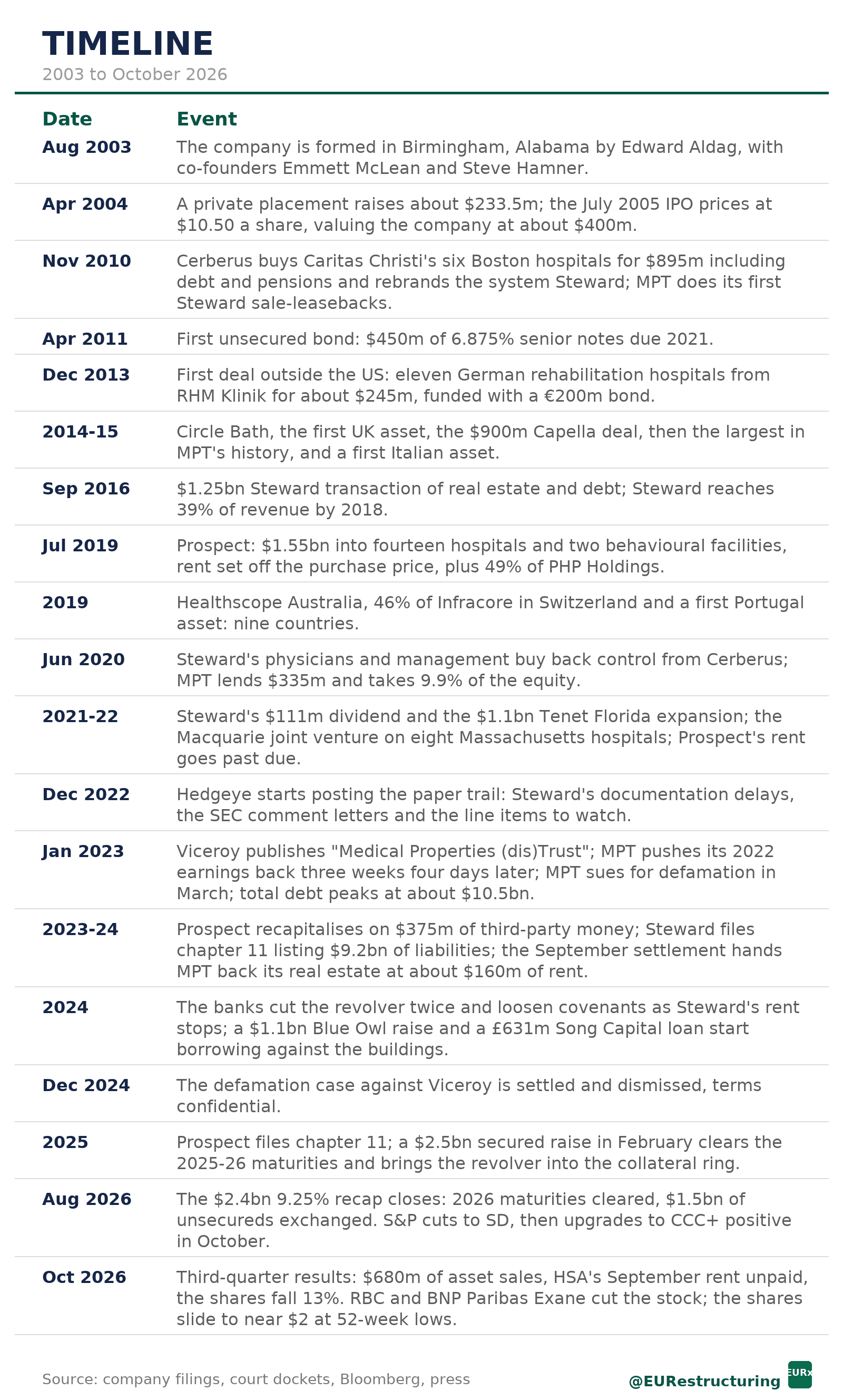
Timeline
The August transaction with GoldenTree
The €500m 0.993% notes came due that October and the revolver ran to the end of December, and with the unsecured market closed to the company at almost any price, another secured raise was the only route. About eighteen months after MPT borrowed roughly $2.5bn of secured money at a blended 7.885%, it tapped the market again at 9.25% for $2.4bn of ten-year money against a portfolio whose two largest tenants had already failed. GoldenTree Asset Management, named as one of the anchor investors, was also no stranger to distressed hospital assets: with Davidson Kempner it owns Quorum Health, acquired out of bankruptcy in 2020.
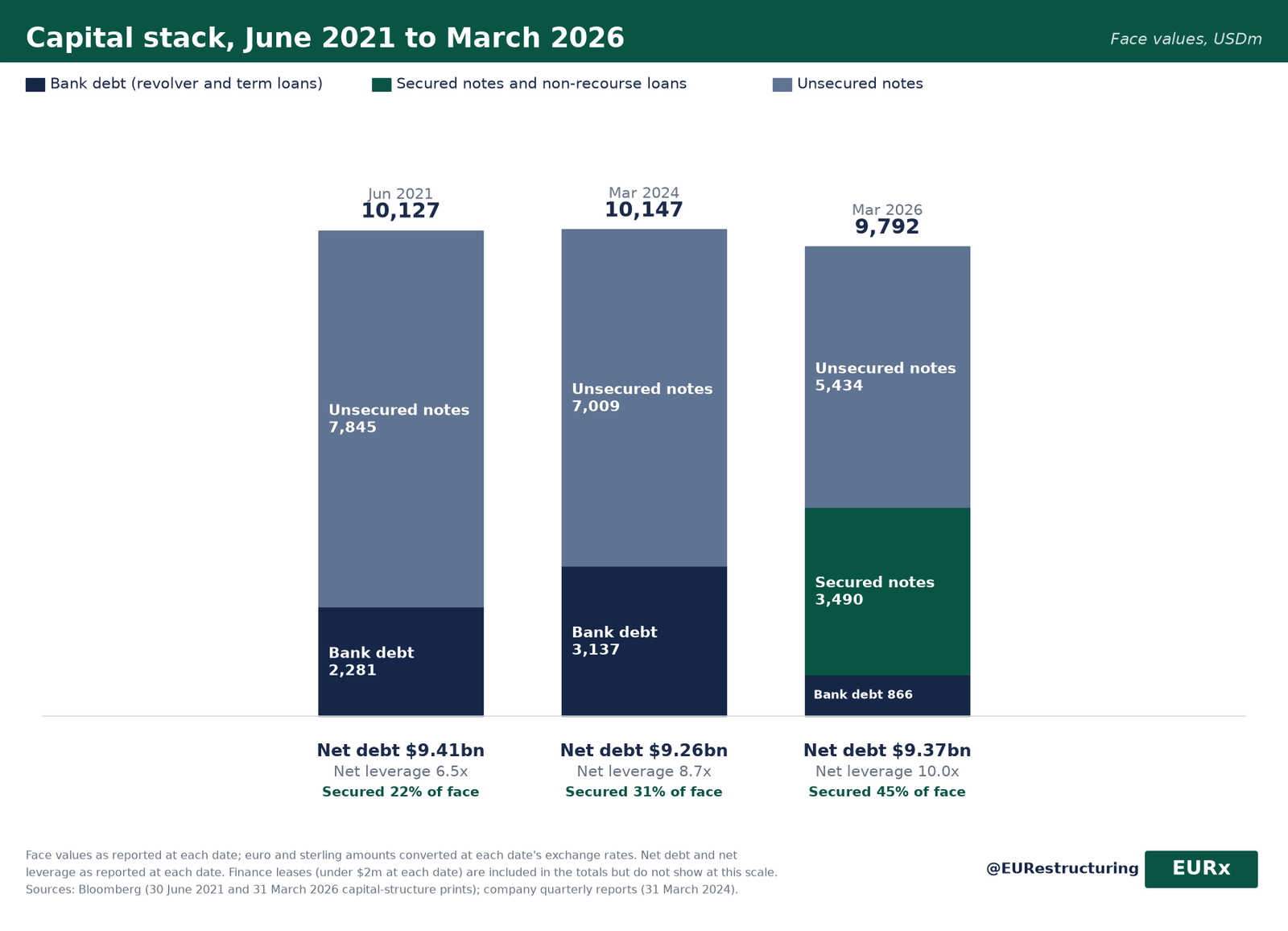
MPT announced the whole package on 10 August as a single $2.4bn transaction: about $1bn of new money alongside a private exchange offer for the five unsecured series due 2027 through 2031, with the new money redeeming the €500m 0.993% notes and 27% of the 5.000% notes, and the company putting the headline benefit at roughly $123m of debt reduction. The exchange leg moved about $1.5bn of the 2027, 2028, 2029, 2030 and 2031 unsecured notes into the new secured notes. The exchanging holders took less than par, and the company booked the difference as a $70m gain in the third quarter. The six unsecured series fell from $5.43bn of face to $2.92bn, while the secured stack grew from $4.40bn to $6.45bn.
The new notes carry a 9.25% coupon, payable 15 June and 15 December from December 2026, and mature on 15 February 2032. Call protection runs a familiar shape: make-whole redemption before 10 August 2028, then a declining premium, plus the standard 40% equity call at 109.250 before the make-whole ends. The August notes were the second act of a secured-borrowing playbook the company had been running since 2024. In February 2025 it had raised $1.50bn of 8.500% and €1.0bn of 7.000% secured notes due 2032, a blended coupon of 7.885%, against first-priority liens on the equity of subsidiaries owning 167 properties leased to 19 operators in the United States, the United Kingdom and Germany. About $2.5bn of net proceeds redeemed in full the €500m 3.325% notes due 2025, the 2.500% notes due 2026 and the 5.250% notes due 2026, with roughly $800m left for general corporate purposes, and a concurrent amendment brought the revolver and term loan into the same collateral ring, ended the Modified Covenant Period and permanently deleted three financial covenants. In 2024 the company had already borrowed against its own buildings: a $1.1bn joint-venture cash raise with Blue Owl over five Utah hospitals in April, and a £631m ten-year loan from Song Capital secured on 27 UK hospitals leased to Circle Health in May.
The covenant record tells the same story from the lenders' side. On 12 April 2024, weeks before Steward filed, MPT's banks cut the revolving commitment from $1.8bn to $1.4bn, lowered the maximum secured leverage ratio from 40% to 25% and waived the 10% cap on unencumbered asset value attributable to tenants in bankruptcy. On 6 August 2024 they loosened the ratios again: the maximum total leverage covenant rose from 60% to 65%, the unsecured leverage cap from 65% to 70%, the minimum unsecured interest coverage ratio fell from 1.75x to 1.45x, the revolver was trimmed to $1.28bn, pricing went to 300 basis points for a Modified Covenant Period set to run to 30 September 2025, and a share of future asset-sale proceeds was swept to repay the revolver and the sterling term loan. February 2025 ended the Modified Covenant Period and removed three covenants outright.
The notes are guaranteed by the company and secured by first-priority liens on the equity of the first-lien guarantor subsidiaries and mortgages on their real estate, subject to foreign collateral limitations. They are also guaranteed by the subsidiaries that back the credit facility and the February 2025 secured notes, and they take a second-priority lien on that collateral once the revolver is refinanced or terminated. The August notes therefore sit inside the same collateral ring as the existing secured debt, ahead of whatever unsecured paper remains.
The covenant package (limits on debt, liens, dividends, affiliate transactions and asset transfers, with unencumbered assets of at least 150% of unsecured debt) is standard for a private deal of this kind, and the operating fact underneath it is that this was a liability-management exercise, not a rescue. No new operator money arrived. The company paid 9.25% for ten-year money because its unsecured market was closed and its existing secured coupons, struck in February 2025 at 7.000% and 8.500%, were no longer available at those levels.
The refinanced stack
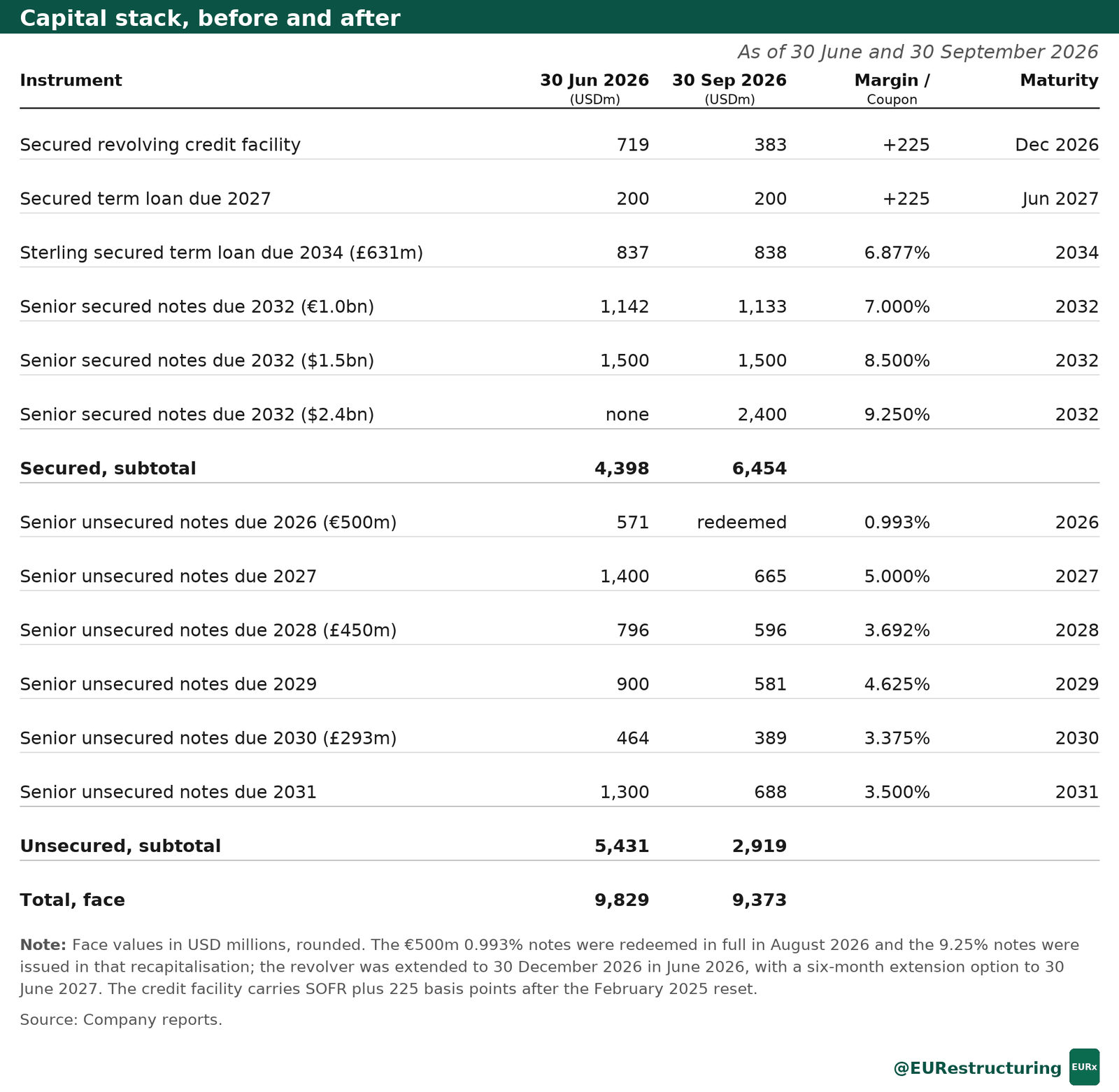
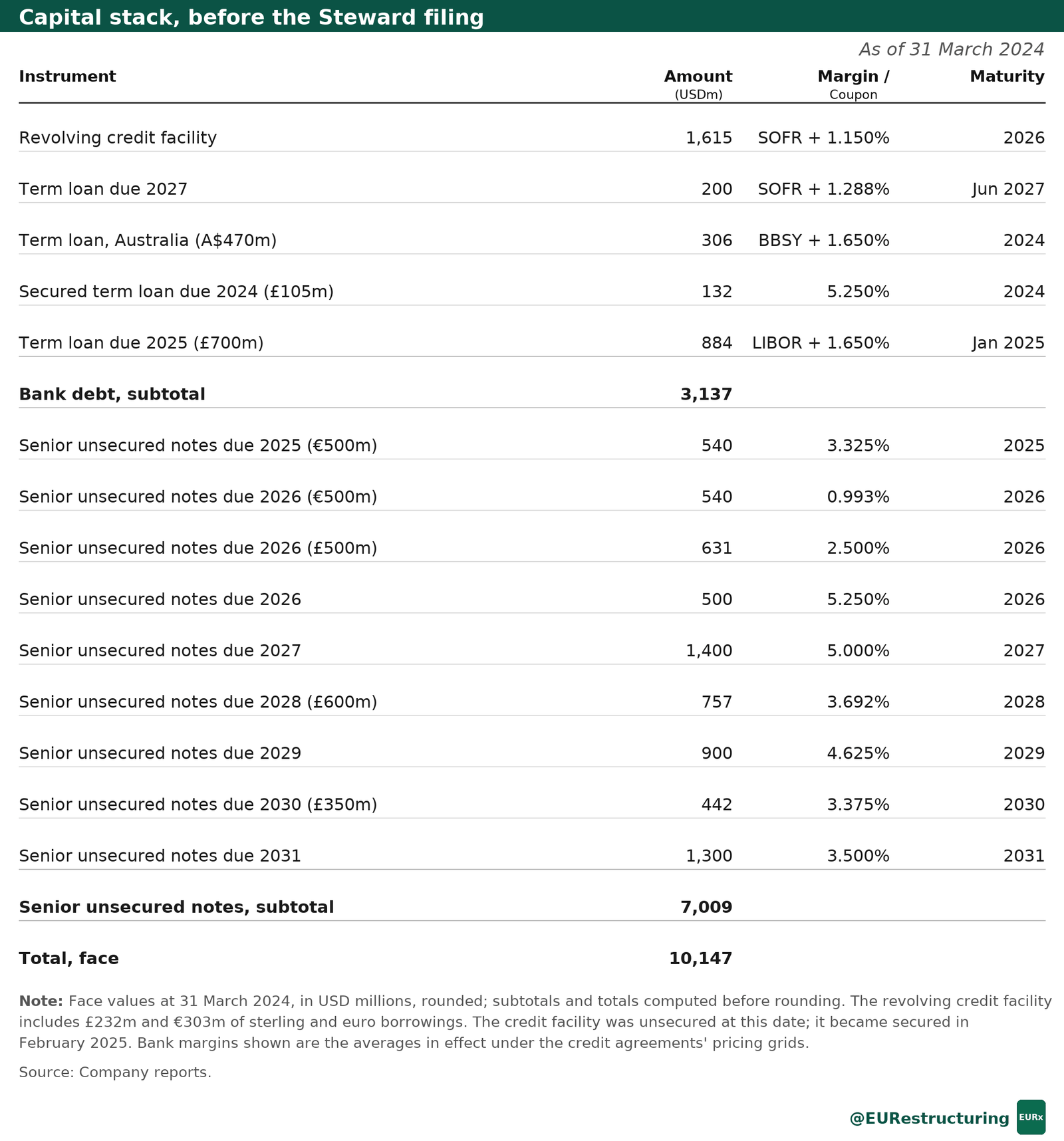
The before column is the debt note in the second-quarter 10-Q; the after column is the third-quarter supplemental. The revolver is drawn down to $383m (including a €100m euro-denominated portion; the Swiss franc tranche was repaid), the 2026 notes are gone, and the five surviving unsecured series were cut back by the cash redemption and the exchange. The £450m and £293m remaining faces of the 2028 and 2030 notes, converted at the September rate, are the 596 and 389 lines above.
Two ratios carry the story. Secured debt went from 45% of the stack to 69%. That shift is the capital-structure repair in one number: unsecured claims cut and pushed behind the secured ring, and the new money carrying the 9.25% coupon the old stack never paid. And the weighted average interest rate on $9.26bn of net debt is now 6.832%, with 94% fixed, against the 3.3% to 5.0% coupons the exchanged paper carried. Adjusted net debt to annualised adjusted EBITDAre stands at 8.7x on the supplemental's own measures, with total leverage at 58.0% of gross assets.
What the quarter showed
The third quarter, reported on 29 October, was the first test of the new stack, and the numbers split cleanly between the balance sheet and the tenants. On the balance sheet side: $680m of asset sales completed in the quarter, including about $174m from the sale of the five Utah partnership properties and roughly $371m from the sale of two Idaho hospitals to Intermountain for $413m at a 6.9% capitalisation rate, generating $158m of gains, with management saying it would use a majority of the proceeds to reduce debt. Assets stand at $14.4bn across 365 properties, about 37,000 licensed beds, 52 operators and nine countries.
On the tenants side: Healthcare Systems of America, the operator that took eight of the fifteen hospitals MPT re-let after the Steward settlement, did not pay its September rent, a $0.02 hit to normalised FFO. MPT's working-capital advances to HSA and its affiliates stood at about $150m at the end of the quarter, and the company has engaged Ovation Healthcare to support the HSA facilities. Management pointed to operational improvement there even as rent stays short: HSA hospital volumes up 14% year on year, surgeries up 33% and the tenant's own cash collections up 24%. NOR Healthcare Systems, which took the six former Prospect California hospitals on a re-lease in December 2025, has kept paying 50% of contractual rent with all payments current, and management expects it to move to 100% in December; the September miss is the warning about how thin these ramps still are.
Priory is the other tenant story of the quarter. NHS budget constraints, which management said have limited funding for behavioural health for several quarters, led MPT and Priory to agree an annual rent reduction of roughly 18%, about £11m, with a variable rent component that can recapture some or all of the cut if patient volumes recover, and an option at MPT's election to extend the lease by ten years to 2055. Management said the rent cut was made at the bottom and that Priory's revenue is already improving. The quarter also carried about $24m of impairment charges, primarily related to the Colombian investments after the August earthquake there.
The reported quarter: net income of $202m, or $0.34 a share, driven by the sale gains and a $70m gain on the refinancing discount; normalised FFO of $64m, or $0.11 a share, below the $0.13 expected; revenue of $250.1m; and a $0.09 dividend. The shares fell 13% on the print. Management pointed to cash collections above $750m for the first three quarters, on track for more than $1bn annualised. The sell side joined after the print. RBC Capital Markets cut the stock to underperform from sector perform on 30 October, taking its price target from $4.50 to $2.00, with analyst Michael Carroll citing deepening tenant vulnerabilities and persistent liquidity headwinds; BNP Paribas Exane followed on 3 November, cutting to neutral from outperform with a $2.25 target from $5.00. The shares kept sliding into early November, trading near $2 at fresh 52-week lows.
The ratings trail
The agencies spent three years walking MPT down and eight weeks walking it part of the way back. S&P cut the corporate rating from BB+ to BB in March 2023, to B+ in February 2024 as the Steward rescue lending mounted, to B- in May 2024, and to CCC+ in November 2024 after the settlement gave away cash rent for the rest of the year. On 12 August 2026, two days after the exchange closed, S&P treated the discount-capture as a distressed exchange and cut to SD⁶. On 7 October 2026 it upgraded to CCC+ with a positive outlook, citing the extended maturity profile and the completed sales.
Moody's moved later and less far: B1 to Caa1 with a negative outlook on 25 November 2024. Its next action came with the refinancing: on 8 October 2026 it affirmed the B3 corporate family rating and the B2 secured and Caa1 senior unsecured ratings, and assigned a B2 to the new $2.40bn secured notes, one notch above the corporate family rating in recognition of the first-lien collateral pool of 26 properties. The speculative-grade liquidity rating was cut to SGL-4 from SGL-3, and the outlook on all entities moved to negative from stable. Moody's laid out the near-term stack: the $1.28bn secured revolver, $445m drawn as of 10 August, expires in December 2026, a $200m term loan matures in June 2027 and $665m of unsecured bonds in October 2027, and it warned that covenant headroom on secured leverage and fixed-charge coverage was already tight as of 30 June, with the incremental secured debt and interest from the new issue capable of tripping those covenants within twelve months absent a waiver. It also flagged Healthcare Systems of America, MPT's third-largest operator by revenue, as not yet paying full rent and in need of working capital support from MPT.
The downgrade path that preceded it maps one-for-one onto Steward. The cuts tracked the tenant's distress, from the rescue lending through the case to the settlement's rent giveaway. What the August deal changed is the structure, not the tenancy, which is why the two agencies now read the same credit differently.
Moody's did not dispute that the balance sheet was repaired; it disputed how much that changes. The one-notch spread on the new notes, the weak-liquidity tag and the negative outlook all say the same thing: the covenant trip, not a second upgrade, is the risk the ratings now carry.
Where this leaves MPT
The August transaction solved the 2026 wall and bought the company to February 2032, but at a full price. The remaining near-dated paper is modest: $665m of 5.000% notes due 2027, the $200m secured term loan, and a revolver backstop that runs to 30 December 2026. The unsecured fight is not settled: the holders who did not exchange still carry the $665m into 2027, and what they recover depends on how the re-tenanted hospitals pay.
Management frames what remains as the second step of the same refinancing. On the third-quarter call it said unencumbered assets covered more than 180% of unsecured debt at 30 September, against the 150% covenant minimum, and that completing step two would lift the ratio to as much as 225%. The step consists of extending and downsizing the roughly $1.3bn revolver, with the secured-leverage covenant removed entirely, permanently repaying the $200m term loan and refinancing the $665m of 2027 notes, which management said would leave no maturities until June 2028, when the sterling notes fall due, and free collateral on the credit facility for further secured financing.
The swing factor is rent. HSA's September miss sits against NOR's scheduled step-up to 100% of contractual cash rent in December, and between them the two decide whether the 8.7x leverage math improves. Behind it sit the standing questions: a litigation trust whose claims run through the 2016 sale-leaseback, a dividend re-based to $0.09, and a tenant base in which two operators, Circle and Priory, are 32% of revenue while the re-tenanted Steward hospitals are still finding their footing.
What happens between now and the HSA step-up decides whether the CCC+ positive rating is the start of a climb or a pause on the way down.
What we’re watching from here
Whether HSA's October cheque arrives, after September's did not, and whether NOR's step-up to 100% in December holds.
The first coupon on the new notes, due 15 December 2026, before the rent ramp is tested.
The revolver, which expires 30 December 2026 with a six-month extension management says it expects to exercise, and the planned new revolver of about $1.3bn that would remove the secured-leverage covenant entirely, the same covenant Moody’s warned is already tight.
The $200m term loan due June 2027 and the $665m of 5.000% notes due October 2027, the first look at the unsecured market after the exchange.
Priory: whether the variable rent component recaptures the roughly £11m annual cut if patient volumes recover, and the MPT option to extend the lease to 2055.
The Steward endgame: the litigation trust’s amended claim for more than $3.4bn, the confirmation appeals still pending before Judge Hanks, the amount the Cerberus settlement file still keeps redacted, and sale-order enforcement against the buyers, where Humana’s appeal is now live.
Ratings: whether S&P’s positive outlook produces a second upgrade, or whether the covenant trip Moody’s warned about arrives first.
Notes
- Note on EBITDAre: EBITDAre is the real-estate industry's standard earnings measure: net income plus interest, income taxes, depreciation and amortisation, real-estate depreciation and amortisation, gains or losses on the sale of real estate and impairments of real-estate assets. Adjusted EBITDAre strips out non-cash items such as straight-line rent and unrealised fair-value movements on top of that. It is not the same measure as the EBITDARM used to test rent coverage earlier in this piece, which strips rent itself out.
- Note on the REIT tax rules: interest on a loan counts towards the trust's qualifying income only where the loan is secured by real property; a loan secured by pledges of a tenant's equity does not qualify, and shares in an operating company are not real-estate assets. A taxable REIT subsidiary may earn any type of income, so the lending sat there instead.
- Note on cross-default and cross-collateralisation: cross-default is where a default under one lease is treated as a default under every other lease and loan in the group, and cross-collateralisation is where the same collateral secures each of them. MPT's leases, mortgage loans and term loans to its operators carried both.
- Note on EBITDARM: EBITDARM is earnings before interest, taxes, depreciation, amortisation, management fees and rent; rent is stripped out to show what is left to pay it.
- Note on avoidance actions: preferences and fraudulent transfers are the two recovery tools under the Bankruptcy Code. Section 547 lets the debtor unwind payments and transfers to creditors made in the 90 days before the petition date, or one year where the recipient was an insider. Section 548 unwinds transfers made within two years of the petition where the debtor intended to hinder, delay or defraud creditors, or received less than reasonably equivalent value while insolvent, and state fraudulent-transfer law applied through section 544 can reach further back. Recovered value re-enters the estate for the creditors under section 550, subject to defences such as ordinary-course payments or new value given by the recipient.
- Note on the SD rating: the exchange itself is the default event. S&P treats an exchange that leaves holders with less than the original promise as a distressed exchange and books it as a default whether or not the company has missed a payment: the discount, the roughly $123m captured from unsecured holders, was the event. The tag is usually short-lived. Once the exchange settled, S&P re-rated the company on its new capital structure, and the 7 October upgrade to CCC+ with a positive outlook reflected the maturity runway now running to 2032, the completed asset sales and the smaller near-term stack.
Sources
- 1. Medical Properties Trust, Form 8-K closing the senior secured notes offering, 10 August 2026 (SEC EDGAR): www.sec.gov/Archives/edgar/data/1287865/000119312526342713/d135389d8k.htm
- 2. Medical Properties Trust, Form 8-K announcing the exchange and purchase agreement, 10 August 2026 (SEC EDGAR): www.sec.gov/Archives/edgar/data/1287865/000119312526341434/d115341d8k.htm
- 3. Medical Properties Trust, third quarter 2026 earnings press release, 8-K Exhibit 99.1, 29 October 2026 (SEC EDGAR): www.sec.gov/Archives/edgar/data/1287865/000119312526437067/d181478dex991.htm
- 4. Medical Properties Trust, quarterly supplemental information, 3Q 2026, 8-K Exhibit 99.2 (SEC EDGAR): www.sec.gov/Archives/edgar/data/1287865/000119312526437067/d181478dex992.htm
- 5. Medical Properties Trust, Form 10-Q for the quarter ended 30 June 2026, debt note and subsequent events (SEC EDGAR): www.sec.gov/Archives/edgar/data/1287865/000119312526342583/0001193125-26-342583-index.htm
- 6. Medical Properties Trust, Form 10-K for the year ended 31 December 2023 (SEC EDGAR): www.sec.gov/Archives/edgar/data/1287865/000119312524023248/0001193125-24-023248-index.htm
- 7. Medical Properties Trust, Form 8-K, Utah joint venture and credit facility amendment, 12 April 2024 (SEC EDGAR): www.sec.gov/Archives/edgar/data/1287865/000119312524100968/d804873d8k.htm
- 8. Medical Properties Trust, Form 8-K, £631m secured loan on 27 UK Circle Health properties, 24 May 2024 (SEC EDGAR): www.sec.gov/Archives/edgar/data/1287865/000119312524147330/d843547d8k.htm
- 9. Medical Properties Trust, Form 8-K, credit agreement covenant relief amendment, 6 August 2024 (SEC EDGAR): www.sec.gov/Archives/edgar/data/1287865/000119312524196518/d869658d8k.htm
- 10. Medical Properties Trust, Form 8-K, global settlement with Steward, 17 September 2024 (SEC EDGAR): www.sec.gov/Archives/edgar/data/1287865/000119312524220733/d838495d8k.htm
- 11. Medical Properties Trust, Form 8-K, $1.50bn 8.500% and €1.0bn 7.000% senior secured notes due 2032, 13 February 2025 (SEC EDGAR): www.sec.gov/Archives/edgar/data/1287865/000119312525028746/d849133d8k.htm
- 12. Medical Properties Trust press release, Medical Properties Trust Takes Control of Its Real Estate From Steward Health Care, 11 September 2024 (Business Wire): www.businesswire.com/news/home/20240911823985/en/Medical-Properties-Trust-Takes-Control-of-Its-Real-Estate-From-Steward-Health-Care
- 13. S&P Global Ratings research updates on Medical Properties Trust, 12 August 2026 (downgrade to SD) and 7 October 2026 (upgrade to CCC+ positive): disclosure.spglobal.com/ratings/en/regulatory/article/-/view/type/HTML/id/3639611
- 14. Bloomberg, Steward Health Files Chapter 11 After Medical Properties Deal, 6 May 2024: www.bloomberg.com/news/articles/2024-05-06/steward-health-files-chapter-11-after-medical-properties-deal
- 15. Becker's Hospital Review, Steward gets interim approval to transfer management of 15 hospitals, 11 September 2024: www.beckershospitalreview.com/legal-regulatory-issues/steward-gets-interim-approval-to-transfer-management-of-15-hospitals/
- 16. Private Equity Stakeholder Project, The Pillaging of Steward Health Care: pestakeholder.org/reports/the-pillaging-of-steward-health-care/
- 17. The Bear Cave, Even More Problems at Medical Properties Trust (MPT), 19 March 2026 (HSA rent ramp): thebearcave.substack.com/p/even-more-problems-at-medical-properties
- 18. Prospect Medical Holdings chapter 11 case information site, Omni Agent Solutions: omniagentsolutions.com/Prospect
- 19. Law360 Bankruptcy Authority, Prospect Medical Gets Deal With MPT To Start Sale Process, 19 March 2025: www.law360.com/bankruptcy-authority/articles/2312533
- 20. TIKR, Medical Properties Trust Sinks 13% as FFO Misses and Tenant Troubles Precluded Payment of September Rent, 29 October 2026: www.tikr.com/blog/medical-properties-trust-sinks-13-as-ffo-misses-and-tenant-troubles-precluded-payment-of-september-rent
- 21. Benzinga, Medical Properties Trust's 80% Fall After Crossing BBB- Cliff, 2 February 2026 (Moody's Caa1 history): www.benzinga.com/Opinion/26/02/50295258/medical-properties-trusts-80-fall-after-crossing-bbb-cliff-heres-why
- 22. Pixabay (cover image): pixabay.com/photos/city-dusk-buildings-urban-sunset-7359471/
- 23. Medical Properties Trust, Form S-1/A as filed 30 December 2005 (SEC EDGAR): www.sec.gov/Archives/edgar/data/1287865/000095014405013119/g98465a1posam.htm
- 24. Medical Properties Trust, company history timeline (medicalpropertiestrust.com): www.medicalpropertiestrust.com/timeline
- 25. Boston Globe, Cerberus says its investment in Steward hospitals yielded an $800 million profit, 2 April 2024: www.bostonglobe.com/2024/04/02/business/cerberus-capital-management-steward-health-care/
- 26. Cerberus Capital Management, statement on the Massachusetts congressional delegation's hearing on Steward Health Care, 3 April 2024: www.cerberus.com/media/statement-from-cerberus-on-massachusetts-congressional-delegations-hearing-related-to-steward-health-care/
- 27. Boston Globe, Steward's private equity owner settles with creditors, 30 July 2026: www.bostonglobe.com/2026/07/30/business/steward-health-care-cerberus/
- 28. Reuters, Medical Properties Trust to invest $1.4 bln in 10 acute care hospitals and a behavioral health facility, 19 May 2017: www.reuters.com/article/idUSFWN1IL0AP/
- 29. Boston Herald, Boston-based health giant to buy 18 hospitals, 20 May 2017: www.bostonherald.com/2017/05/20/boston-based-health-giant-to-buy-18-hospitals/
- 30. Private Equity Stakeholder Project, The pillaging of Steward Health Care: Appendix B: pestakeholder.org/the-pillaging-of-steward-health-care-appendix-b/
- 31. Moody's Ratings, ratings alert: Medical Properties Trust, Inc. — B3 corporate family rating affirmed, B2 assigned to the new $2.40bn senior secured notes, speculative grade liquidity rating cut to SGL-4, outlook revised to negative, 8 October 2026 (via subscriber access)
- 32. Medical Properties Trust press release, MPT Announces Agreement for $2.4 Billion Private Refinancing Transaction Expected to Extend Debt Maturities to 2032 and Reduce Debt by Approximately $123 Million, 10 August 2026: investor.mpt.com/news/news-details/2026/MPT-Announces-Agreement-for-2-4-Billion-Private-Refinancing-Transaction-Expected-to-Extend-Debt-Maturities-to-2032-and-Reduce-Debt-by-Approximately-123-Million/default.aspx
- 33. Medical Properties Trust press release, MPT Completes the Sale of Two Hospitals for $371 Million in Cash, 16 September 2026: ir.medicalpropertiestrust.com/news/news-details/2026/MPT-Completes-the-Sale-of-Two-Hospitals-for-371-Million-in-Cash/default.aspx
- 34. Benzinga, Medical Properties Trust Q3 2026 earnings call transcript, 29 October 2026: www.benzinga.com/news/26/10/62704552/medical-properties-trust-q3-2026-earnings-call-transcript
- 35. Healthcare Dive, Steward Health Care files for Chapter 11 bankruptcy, 6 May 2024: www.healthcaredive.com/news/steward-health-care-files-chapter-11-bankruptcy/714050/
- 36. Kroll Restructuring Administration, In re Steward Health Care System LLC, Case No. 24-90213 (Bankr. S.D. Tex.): restructuring.ra.kroll.com/steward/
- 37. CourtListener RECAP, In re Steward Health Care System LLC, No. 24-90213 (Bankr. S.D. Tex.), docket entries 4888-6814: www.courtlistener.com/docket/68501909/steward-health-care-system-llc/
- 38. Healthcare Finance News, DOJ files objection to Steward's bankruptcy deal, 31 May 2024: www.healthcarefinancenews.com/news/doj-files-objection-stewards-bankruptcy-deal
- 39. Healthcare Dive, 'We're always running out of money': Steward seeks new DIP financier, 4 June 2024: www.healthcaredive.com/news/steward-seeks-dip-financing-amid-liquidity-crisis/717959/
- 40. Healthcare Dive, Steward secures $225M days before it was set to run out of cash, 11 June 2024: www.healthcaredive.com/news/steward-health-care-secures-financing-bankruptcy/718565/
- 41. Becker's Hospital Review, Steward hospital funding approved, but bid concerns linger, 14 June 2024: www.beckershospitalreview.com/finance/steward-hospital-funding-approved-but-bid-concerns-linger/
- 42. Healthcare Dive, Steward contends with possible facility closures as DIP financing falls short, 14 June 2024: www.healthcaredive.com/news/steward-hospitals-close-bankruptcy/719002/
- 43. PacerMonitor, Steward Health Care System LLC v. Medical Properties Trust, Inc. et al, Adv. Proc. No. 4:24-ap-03168 (Bankr. S.D. Tex., filed 19 August 2024): www.pacermonitor.com/public/case/54774141/Steward_Health_Care_System_LLC_v_Medical_Properties_Trust,_Inc_et_al
- 44. Business Wire, Steward Health Care and Medical Properties Trust Reach Settlement Agreement in Principle, 30 August 2024: www.businesswire.com/news/home/20240830003991/en/Steward-Health-Care-and-Medical-Properties-Trust-Reach-Settlement-Agreement-in-Principle-Allowing-for-Steward-Operated-Hospitals-to-Be-Transitioned-to-New-Ownership
- 45. WUSF, A bankruptcy judge gives OK to a settlement that will keep open South Florida hospitals, 11 September 2024: www.wusf.org/health-news-florida/2024-09-11/bankruptcy-judge-orlando-health-steward-space-coast-hospitals
- 46. Healthcare Dive, Steward inks deal to slash debt, keep most remaining hospitals open, 12 September 2024: www.healthcaredive.com/news/steward-mpt-deal-keep-hospitals-open-slashes-debt/726706/
- 47. Healthcare Dive, Steward Health Care auction: What assets sold, closed and are still up for grabs: www.healthcaredive.com/news/steward-health-care-auction-what-assets-sold-closed-and-are-still-up-for/725230/
- 48. Becker's Hospital Review, Judge OKs sale of 7 Steward hospitals to American Healthcare Systems affiliate, 25 October 2024: www.beckershospitalreview.com/hospital-transactions-and-valuation/judge-oks-sale-of-7-steward-hospitals-to-american-healthcare-systems-affiliate/
- 49. Becker's ASC, What's new with Steward Health Care?, 13 November 2024: www.beckersasc.com/asc-transactions-and-valuation-issues/whats-new-with-steward-health-care/
- 50. Reuters, Steward Health gets green light to repay creditors with litigation proceeds, 16 July 2025: www.reuters.com/legal/litigation/steward-health-gets-green-light-repay-creditors-with-litigation-proceeds-2025-07-16/
- 51. D Magazine, Steward Health Care Sues Former CEO Dr. Ralph de la Torre and Other Execs for Allegedly Stealing Hundreds of Millions, 22 July 2025: www.dmagazine.com/healthcare-business/2025/07/steward-health-care-sues-former-ceo-dr-ralph-de-la-torre-and-execs-for-stealing-hundreds-of-millions-of-dollars/
- 52. D Magazine, Battle of the Hospital Systems: Why Steward Is Suing Tenet, 6 August 2025: www.dmagazine.com/healthcare-business/2025/08/battle-of-the-hospital-systems-why-steward-is-suing-tenet/
- 53. Weil, Gotshal & Manges, Weil Secures Confirmation of Steward Health Care System's Chapter 11 Plan, 28 July 2025: www.weil.com/articles/weil-secures-confirmation-of-steward-health-care-systems-chapter-11-plan
- 54. Becker's Hospital Review, Judge OKs Steward Chapter 11 plan, 29 July 2025: www.beckershospitalreview.com/finance/judge-oks-steward-chapter-11-plan/
- 55. Bloomberg Law, Steward Health Trustee Expands Claims Against Ex-CEO, Insiders, 24 November 2025: news.bloomberglaw.com/bankruptcy-law/steward-health-trustee-expands-claims-against-ex-ceo-insiders
- 56. D Magazine, Steward Health Care Trustee Files $3.4 Billion Lawsuit Against Former CEO Dr. Ralph de la Torre and Other Former Execs, 2 December 2025: www.dmagazine.com/healthcare-business/2025/12/steward-health-care-trustee-files-3-4-billion-lawsuit-against-former-ceo-dr-ralph-de-la-torre-and-other-former-execs/
- 57. Becker's Hospital Review, Steward trustee seeks amended $3.4B complaint against ex-CEO, 4 December 2025: www.beckershospitalreview.com/legal-regulatory-issues/steward-trustee-seeks-3-4b-in-amended-complaint-against-ex-ceo/
- 58. Reuters, Bankrupt Steward Health approved to sell six Massachusetts hospitals at a loss, 4 September 2024: www.reuters.com/business/healthcare-pharmaceuticals/bankrupt-steward-health-approved-sell-six-massachusetts-hospitals-loss-2024-09-04/
- 59. WBUR, State officially seizes St. Elizabeth's hospital, 27 September 2024: www.wbur.org/news/2024/09/27/st-elizabeths-hospital-eminent-domain-healey-steward
- 60. WBUR, St. Elizabeth's Medical Center's property owner sues state over eminent domain taking, 1 November 2024: www.wbur.org/news/2024/11/01/massachusetts-steward-hospital-eminent-domain-lawsuit
- 61. The Boston Globe, The bill to acquire St. Elizabeth's Medical Center is in: $66 million, 1 August 2025: www.bostonglobe.com/2025/08/01/business/steward-st-elizabeths-eminent-domain/
- 62. Medical Properties Trust press release, pricing of $1.5bn 8.500% and €1.0bn 7.000% senior secured notes due 2032, 31 January 2025 (Business Wire): www.businesswire.com/news/home/20250130801790/en/Medical-Properties-Trust-Announces-Pricing-of-1.5-Billion-8.500-Senior-Secured-Notes-Due-2032-and-1.0-Billion-7.000-Senior-Secured-Notes-Due-2032
- 63. Medical Properties Trust press release, closes $800m (£631m) 10-year loan secured by U.K. hospital portfolio (Song Capital), 24 May 2024 (Business Wire): www.businesswire.com/news/home/20240523572008/en/Medical-Properties-Trust-Closes-800-Million-10-Year-Loan-Secured-by-U.K.-Hospital-Portfolio
- 64. CourtListener RECAP, In re Prospect Medical Holdings, Inc., No. 25-80002 (Bankr. N.D. Tex., Jernigan, J.), docket entries 341, 345, 2459: www.courtlistener.com/docket/69537289/prospect-medical-holdings-inc/
- 65. CourtListener RECAP, Medical Properties Trust, Inc. v. Prospect Medical Holdings, Inc., No. 3:25-cv-00247 (N.D. Tex.): www.courtlistener.com/docket/70743069/medical-properties-trust-inc-v-prospect-medical-holdings-inc/
- 66. Medical Properties Trust press release, Medical Properties Trust Provides Update on Steward Health Care, 4 January 2024 (Business Wire): businesswire.com/news/home/20240104928323/en
- 67. Medical Properties Trust press release, Medical Properties Trust, Inc. Reports First Quarter Results, 9 May 2024 (Business Wire): www.businesswire.com/news/home/20240508183707/en/Medical-Properties-Trust-Inc.-Reports-First-Quarter-Results
- 68. Steward Health Care/Cerberus press release, Steward Receives $1.25 Billion Investment from Medical Properties Trust, Setting Stage for National Growth, 26 September 2016 (PR Newswire): www.prnewswire.com/news-releases/steward-receives-125-billion-investment-from-medical-properties-trust-setting-stage-for-national-growth-300334227.html
- 69. Healthcare Finance News, Losses mount for Steward Health Care as concern over its future grows, 17 March 2015: www.healthcarefinancenews.com/news/losses-mount-steward-health-care-concern-over-its-future-grows
- 70. Healthcare Dive, What's going on at Steward Health Care?, 15 February 2024: www.healthcaredive.com/news/steward-health-care-distress/706940/
- 71. Healthcare Dive, Steward bankruptcy likely as massive debt remains, with few options left, 16 April 2024: www.healthcaredive.com/news/steward-health-care-bankruptcy-risk/712899/
- 72. WBUR, Steward Health Care has kept financial information secret for years. Now, it faces a demand, 23 February 2024: www.wbur.org/news/2024/02/23/steward-health-care-audited-financial-statements-healey-deadline
- 73. Boston Globe, House of cards: How a real estate firm and Steward Health Care grew in tandem, in part by keeping Steward's shaky finances secret, September 2024: apps.bostonglobe.com/metro/investigations/spotlight/2024/09/steward-hospitals/steward-mpt/
- 74. Wikipedia, Steward Health Care: en.wikipedia.org/wiki/Steward_Health_Care
- 75. Wikipedia, Prospect Medical Holdings: en.wikipedia.org/wiki/Prospect_Medical_Holdings
- 76. Medical Properties Trust press release, Medical Properties Trust Announces $1.75 Billion Investment in 24 Hospital Facilities, 15 July 2019 (SEC-filed exhibit): www.sec.gov/Archives/edgar/data/1287865/000119312519194003/d772889dex991.htm
- 77. Becker's Hospital Review, Medical Properties Trust invests $2B in 24 hospitals, 27 August 2019: www.beckershospitalreview.com/hospital-transactions-and-valuation/medical-properties-trust-invests-2b-in-24-hospitals/
- 78. OCCRP, Deal With Real-Estate Investment Trust Helps Bring Down Another U.S. Hospital Operator: www.occrp.org/en/investigation/deal-with-real-estate-investment-trust-helps-bring-down-another-hospital-operator
- 79. OCCRP, How Private Equity and an Ambitious Landlord Put Steward Health Care on Life Support, 9 October 2024: www.occrp.org/en/investigation/how-private-equity-and-an-ambitious-landlord-put-steward-healthcare-on-life-support
- 80. Private Equity Stakeholder Project, Private Equity Hospital Tracker (October 2026): pestakeholder.org/reports/private-equity-hospital-tracker-fall2026/
- 81. Medical Properties Trust, Annual Report on Form 10-K for the year ended 31 December 2021 (SEC EDGAR): www.sec.gov/Archives/edgar/data/1287865/000156459022008100/mpw-10k_20211231.htm
- 82. Medical Properties Trust, Annual Report on Form 10-K for the year ended 31 December 2022 (SEC EDGAR): www.sec.gov/Archives/edgar/data/1287865/000095017023005575/mpw-20221231.htm
- 83. Medical Properties Trust, Form 10-Q for the quarter ended 31 March 2023 (SEC EDGAR): www.sec.gov/Archives/edgar/data/1287865/000095017023020652/0000950170-23-020652-index.htm
- 84. Medical Properties Trust, Form 10-Q for the quarter ended 30 June 2023 (SEC EDGAR): www.sec.gov/Archives/edgar/data/1287865/000095017023040734/mpw-20230630.htm
- 85. Medical Properties Trust, Annual Report on Form 10-K for the year ended 31 December 2023 (SEC EDGAR): www.sec.gov/Archives/edgar/data/1287865/000095017024023248/mpw-20231231.htm
- 86. Medical Properties Trust, quarterly supplemental information, fourth quarter 2022, 8-K Exhibit 99.2 (SEC EDGAR): www.sec.gov/Archives/edgar/data/1287865/000119312523045747/d457057dex992.htm
- 87. Viceroy Research, Medical Properties (dis)Trust, 26 January 2023: viceroyresearch.org/2023/01/26/medical-properties-distrust/
- 88. Medical Properties Trust, Inc. v. Viceroy Research, LLC, No. 2:23-cv-00408 (N.D. Ala., filed 30 March 2023), CourtListener docket: www.courtlistener.com/docket/67117032/medical-properties-trust-inc-v-viceroy-research-llc/
- 89. Jenna Carlesso and Dave Altimari, Yale seeks state funding, lower price for Prospect Medical hospitals, CT Mirror, 11 October 2023: ctmirror.org/2023/10/11/prospect-medical-holdings-ct-sale-yale/
- 90. Jenna Carlesso and Dave Altimari, Yale Health wants $80M from CT for Prospect hospitals deal, sources say, CT Mirror, 16 October 2023: ctmirror.org/2023/10/16/prospect-medical-holdings-ct-hospitals-yale-deal/
- 91. Medical Properties Trust, Prospectus 424B3, 6 October 2006 (SEC EDGAR): www.sec.gov/Archives/edgar/data/1287865/000095014406009332/g03446b3e424b3.htm
- 92. Medical Properties Trust press release, completes acquisition of 11 rehabilitation facilities in Germany (RHM), 3 December 2013 (Business Wire): www.businesswire.com/news/home/20131203005998/en/Medical-Properties-Trust-Completes-Acquisition-11-Rehabilitation
- 93. Investing.com, RBC Capital downgrades Medical Properties Trust stock rating on tenant issues, 30 October 2026: www.investing.com/news/analyst-ratings/rbc-capital-downgrades-medical-properties-trust-stock-rating-on-tenant-issues-93CH-4986130
- 94. Investing.com, BNP Paribas Exane downgrades Medical Properties Trust stock rating on tenant concerns, 3 November 2026: www.investing.com/news/analyst-ratings/bnp-paribas-exane-downgrades-medical-properties-trust-stock-rating-on-tenant-concerns-93CH-4993696
- 95. Hedgeye, X posts on MPT’s delayed audited financials and Steward's reporting obligations, 15, 19 and 22 December 2022: x.com/HedgeyeREITs/status/1603517771869986839, x.com/HedgeyeREITs/status/1604867943338221568, x.com/HedgeyeREITs/status/1606018560177762305
- 96. Viceroy Research, X post on the delayed 2022 earnings announcement, 30 January 2023: x.com/viceroyresearch/status/1620073730969042944
- 97. Hedgeye, X post, Where's the SEC on Upholding the Law?, 27 September 2023: x.com/Hedgeye/status/1707120555936166266
- 98. Medical Properties Trust press release, Medical Properties Trust Announces Settlement with Viceroy Research, 18 December 2024: ir.medicalpropertiestrust.com/news/news-details/2024/Medical-Properties-Trust-Announces-Settlement-with-Viceroy-Research-12-18-2024/
- 99. OCCRP, Former Landlord of Bankrupt Steward Health Care Drops U.S. Defamation Case, 24 December 2024: www.occrp.org/en/news/former-landlord-of-bankrupt-steward-health-care-drops-us-defamation-case