Case Summaries · Business services
KronosNet: forbearance on ~€1.2bn as the AI transition stalls
KronosNet skipped a €44m coupon and entered forbearance on more than €1.1bn of debt. The lender proposal on the table equitises the entire stack, wiping out ICG and founder José María Pacheco, while generative AI reshapes the economics of the outsourcing business.
KronosNet, the Intermediate Capital Group-controlled customer-experience business process outsourcing (CX BPO) group, opted not to make a €44m interest payment on Monday 26 October. Enough of its lenders agreed to hold off on enforcement while the company and its creditors negotiate ways to cut its debt, which stands at more than €1.10bn.
The company has hired Houlihan Lokey as its financial adviser and A&O Shearman as counsel, and has opened formal talks with its shareholders and the majority of the financial creditors under its senior facilities agreement. The stated aims are new resources, a lower cost of debt and longer maturities, with the capitalisation of part or all of the debt among the options. Both sides are aiming for a deal by year end.
Key terms
- Company
- KronosNet, the customer-experience and business process outsourcing group behind KronosNet Topco S.L., formed in 2022 by the combination of Spain's Konecta and Italy's Comdata. Operates in 26 countries with around 105,000 employees.
- Ownership
- ICG owns the majority (75+%). Founder and chairman José María Pacheco and other minority shareholders hold the rest.
- Trigger
- An interest payment of €44m was not made on 26 October 2026.
- Process
- Out-of-court negotiations with creditors under the senior facilities agreement, after a forbearance request.1
- Debt
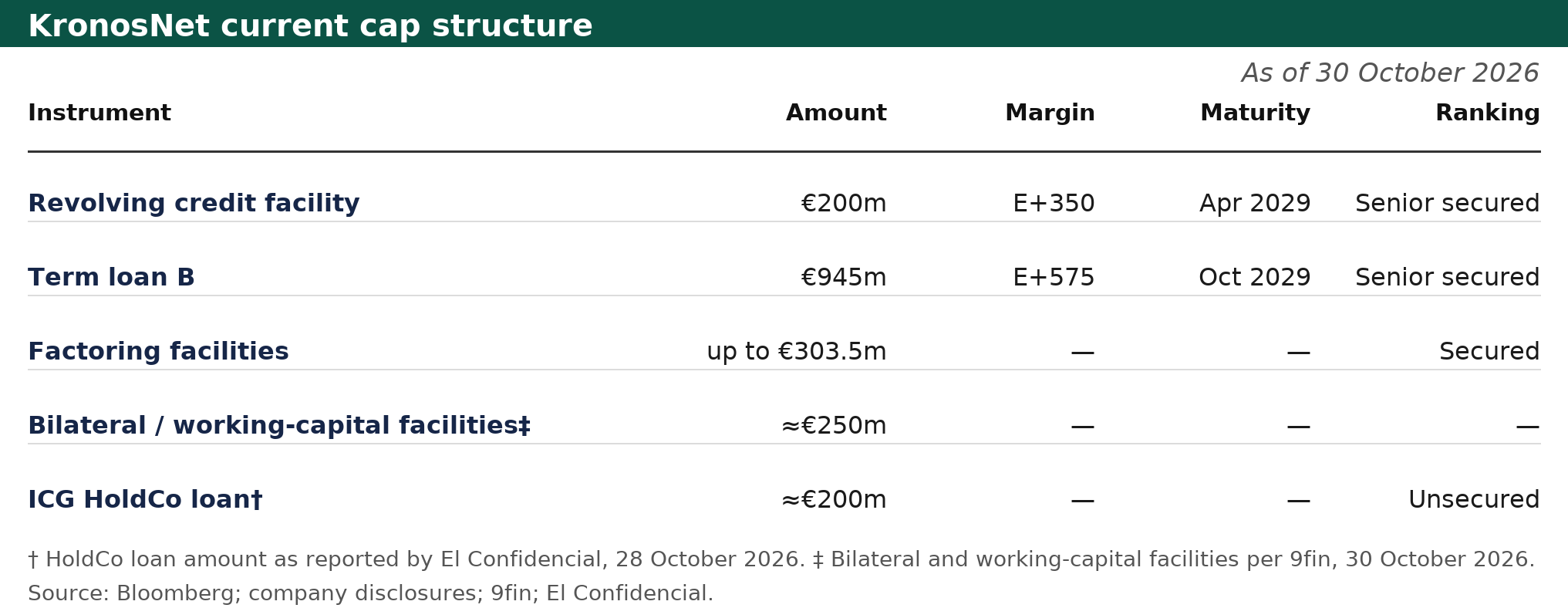
- A €945m senior secured term loan B priced at EURIBOR+575 and a €200m revolving facility, both due 2029 (the TLB in October, the RCF in April), plus factoring facilities of up to €303.5m.
- Trading
- The TLB traded at around 20c on 30 October, down from the mid-40s the week before and the mid-60s in March.
- Advisers
- Houlihan Lokey (financial) and A&O Shearman (legal) for the company; Gibson Dunn (legal) and PJT Partners (financial) for the TLB lenders.
- Next steps
- Reported conversion of a significant portion of debt into equity; deal targeted before year-end.
How we got here: two roll-ups, one buyout
Konecta: the Spanish roll-up
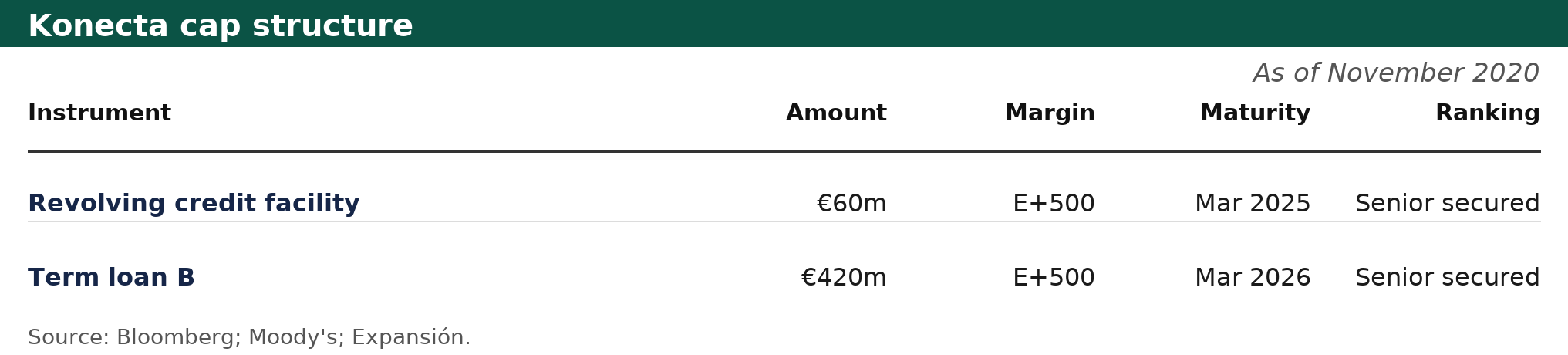
Konecta was founded in Seville in 2000 by José María Pacheco, then working in Santander's finance arm, who persuaded the bank to outsource its call-centre operations. Santander held 40% at the outset, Pacheco 25% and Liberty Seguros (the Spanish insurance business of the US insurer Liberty Mutual) 10%. PAI Partners bought 40% in 2015, a deal reported at the time at around €130m for the stake, valuing the group at a little over €300m. Under PAI the business grew quickly: revenue rose from around €400m in 2014 to €770m in 2017 and €830m in 2018, while EBITDA grew from roughly €30m to about €85m, helped by the B-Connect and Allus acquisitions in Mexico and Argentina. In February 2019, Santander and PAI exited, and the management team led by Pacheco (alongside new sponsor ICG) acquired 100% of the business in a deal the Spanish press put at around €700m.
The buyout was funded by a €380m debt package (a €320m TLB and a €60m RCF) arranged in March 2019, alongside €316m of equity and shareholder loans: Pacheco rolled the roughly €140m gain on his existing stake back into the new holding company, ICG invested a similar amount, and management took 50.1% of the equity to ICG's 49.9%. Leverage at close stood at about 4.5x EBITDA, and Moody's assigned a B2 corporate family rating. In November 2020, Konecta raised a fungible €100m TLB add-on to fund the acquisition of Spanish outsourcing group Rockethall. By 2021, Konecta had 74,000 employees and was doing ~€900m of revenue.
Comdata, Carlyle and the 2021 restructuring
Comdata, the Italian half of KronosNet, was founded in Turin in 1987. By 2014 the company had 14,000 employees and was doing around €350m in revenue. Carlyle and management acquired 92.5% of the business in a €240m deal (the reported consideration; MF Milano Finanza put the enterprise value at around €300–350m) completed in February 2016. Carlyle financed the buyout with around €170m of acquisition debt, roughly 4x EBITDA, which stood at €40m in 2014. By 2017 Comdata carried a €355m seven-year TLB and a €70m six-year RCF, and the company continued to grow via M&A: Digitex, a Spanish group with delivery centres across Latin America, acquired in February 2016; four French subsidiaries of the Izium group acquired in June 2017 for a reported €200m; Overtop in Spain and the spin-off of Wind Tre's customer-care activities, both in 2017; and the Czech operator Comgate's call-centre business in July 2018. Revenue rose from about €350m in 2015 to €956m by 2019, but EBITDA grew far more slowly, from €40m in 2014 to €76m in 2019, and margins fell from around 13% to 8%.
Comdata was facing a structural problem: about half of its revenues from France and Italy (and more in Spain) came from telecom operators, whose increasing shift from call centres to digital channels was eating into volumes. Comdata struggled to shift resources offshore (only its France operations could effectively shift labour), and increased competition squeezed margins. Despite the revenue growth, Moody's put gross leverage at 8.2x at the end of 2019. The reality was the business was only growing via acquisitions (no organic expansion).
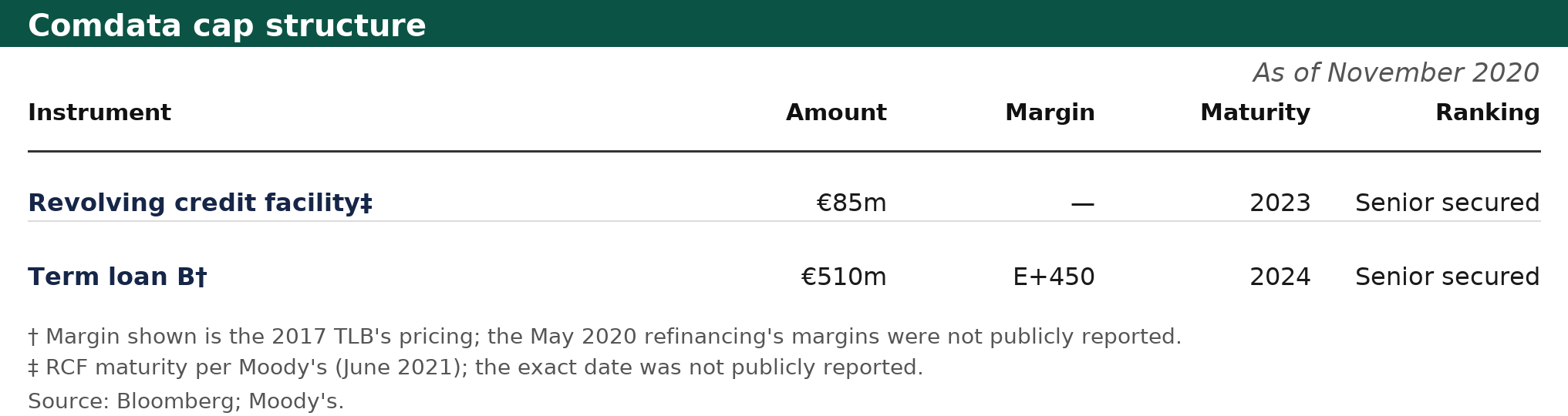
In December 2019, Carlyle and lenders agreed a covenant reset in exchange for more equity (Carlyle injected around €25m). By May 2020 Comdata carried a €510m term loan B due 2024 plus an €85m revolver. With Covid disrupting the business that year and performance deteriorating further—2020 revenue slipped about 6% to €897m, and EBITDA nearly halved to €39m, pushing gross leverage to around 11x—Comdata's liquidity position tightened. Around this time, the TLB lenders began to organise and hired financial and legal advisers.
In November 2020, under mounting financial and operational stress, Comdata sent lenders a workout plan to convert 30% of its debt into SFPs (strumenti finanziari partecipativi)2 and rightsize its capital structure. RCF lenders backed the plan but TLB lenders pushed for additional changes, including clarity around an exit in a shorter timeframe.
By early 2021 negotiations had reached an impasse, and Comdata’s debt traded lower on the uncertainty. Lenders sold their RCF and TLB exposures, some at distressed levels. Carlyle and lenders finally reached a breakthrough that March, via a preliminary restructuring agreement, to be implemented out of court under Article 67 of Italy's insolvency code. Cheyne Capital, which purchased chunks of Comdata debt during this period, agreed in April 2021 to provide €25m of super senior new money to help get the deal over the line.
Ultimately Carlyle and creditors agreed to convert around 30% of debt into SFPs and move reinstated debt into a new SPV.3 In exchange for the debt haircut, lenders received 40% of the equity. Adjusted gross leverage, which had climbed from 8.2x at the end of 2019 to around 11x pre-restructuring, would be cut to around 8x post deal, per Moody's. Moody's assigned a Caa3 rating with a limited default designation through the restructuring (marking what the agency treated as a distressed exchange), before upgrading Comdata back to Caa1 on 30 August 2021. A reinstated €375m senior secured loan due 2024 replaced the €510m TLB and €85m RCF. Carlyle put the company on the block in late 2021, at a reported ~€1bn valuation.
The 2022 combination
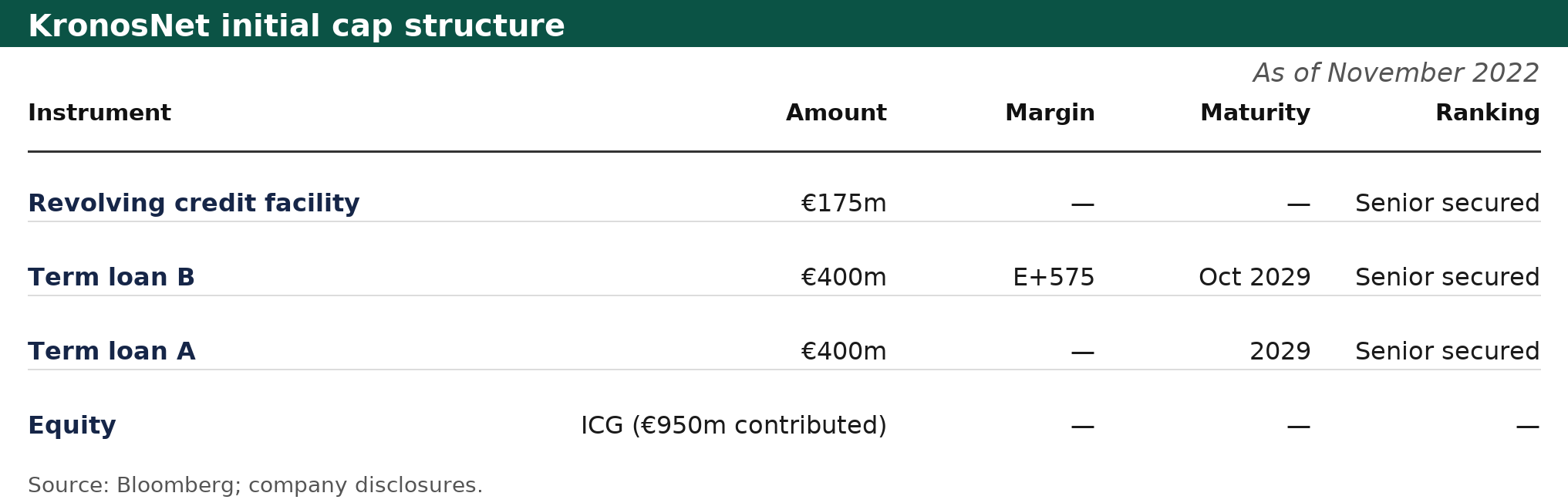
The combination took shape in early 2022, as Konecta and Comdata announced they would join forces to create KronosNet. The combined business would be the sixth-largest player in the CX BPO market, with close to €2bn of revenue and more than 130,000 employees. ICG (along with Pacheco) would remain as financial sponsor, backing the combination with a €950m equity contribution.
To finance the new business, ICG raised €975m in debt comprised of a €400m seven-year TLB (priced in September 2022 at Euribor+575 and 92 OID), alongside a €400m TLA and a €175m RCF.4 Moody's assigned the new business a B2 corporate family rating in September and S&P followed with a B+ rating in November. KronosNet would have pro forma net leverage of 3.8x (targeting <1.5x by 2026), consolidated adjusted EBITDA of €278m, and was guiding to FCF >€200m by 2026.
Lenders supported the business combination, but flagged the risks that would matter later, in particular the company's Latin American exposure, which would subject it to FX and wages / political risk sitting outside of European labour frameworks.
In December 2022, the company priced a €95m fungible TLB add-on at the same OID / margin as the existing, with the proceeds partly repaying the €400m TLA. A further €158m fungible add-on followed in April 2023, again to partially repay the TLA. A €70m fungible add-on in October 2023 took the term loan to €870m, this time to repay RCF drawings.
From B+ to B-
Revenue growth at the new KronosNet was modest in 2023, but higher than anticipated integration costs, delays in passing cost inflation on to clients and lower demand from existing European clients in the second half of the year resulted in weaker-than-expected EBITDA and negative FCF. Net leverage drifted higher. By July 2023 S&P put its B+ rating on negative outlook, followed by a downgrade to B in December.
By autumn 2024 the squeeze was visible: KronosNet had about €108m of liquidity against roughly €60m of short-term debt, with another €80m or so of liquidity needed over the following twelve months to fund some €60m of capex and an expected €20–25m working capital outflow. The company told lenders it expected to stay cash-flow negative through 2024 and 2025. Moody's cut its corporate rating to B3 (stable outlook) that October, citing higher than expected leverage from modest revenue growth, higher integration costs, and the spectre of prolonged negative FCF. The RCF, upsized by €25m to €200m in mid-2023, carried a springing net leverage covenant5 of 7.5x, tested only when drawings exceeded 40% of the facility, and net leverage stood at 5.9x on LTM EBITDA of €267m (€297m after the group's cost-saving initiatives).
In January 2025 the company announced Katalyst 2028, a three-year plan concentrated on higher margin generative AI and digital services under a new CEO (Nourdine Bihmane) targeting €2.5bn of revenue by 2028 (30–40% of it from GenAI-powered digital services) as well as significant margin expansion. ICG put €75m of fresh equity behind the plan, and the TLB rallied. KronosNet also raised a further €75m fungible TLB add-on, growing the tranche to €945m in aggregate.
2026: the cash burn accelerates
Q1 2026 numbers came in a touch below expectations (revenue of €499m vs. €506m budget, EBITDA €65.5m just below €66m budget). Of greater concern was free cash flow: KronosNet burned more than €37m in the quarter via working capital outflows, driven by Colombia's 24% minimum-wage increase and the lag in pass-through invoicing and collecting. Q1 2026 net secured debt stood above €1bn, >3x consolidated adjusted LTM EBITDA. S&P had moved its B rating to a negative outlook in March, forecasting slower revenue growth in key markets, increasing AI-driven pricing pressure and risk of FCF / interest coverage ratio deterioration. Lenders looked ahead to Q2 results with a hope of stabilising losses and liquidity.
In H1 2026, KronosNet posted over €1bn in revenues and EBITDA of €137m, but cash flows did not recover; the company posted negative LTM FCF of €103m (versus +€92m of FY25 and +€51m of FY24), driven by working capital outflows, one-off costs and capex spend to fund the company's AI buildout. Liquidity fell to €132m from ~€167m at the end of Q1 (and €221m at the end of FY25), driven by cash burn rather than incremental revolver drawings, and net cash dropped from €83.2m at the end of Q1 to €54.8m at 30 June.
On 8 October, S&P cut KronosNet to B- (negative outlook) on persistently negative cash flow generation and liquidity pressure, forecasting negative free operating cash flow after leases of €50m in 2026 and 2027.
Eighteen days later the company was out of runway: with ~€55m of cash against a €44m coupon payment due 26 October, it opted to defer payment and asked its TLB lenders for forbearance, keeping enforcement off the table while it negotiated a recapitalisation.
The talks
Leading up to the forbearance, the company hired Houlihan Lokey, while TLB lenders hired Gibson Dunn as counsel and PJT as financial adviser. Cuatrecasas is advising a separate group of undisclosed creditors. Both sides are targeting an agreement by year end, but this time the potential debt equitisation contemplated is likely to be much larger. Loanholders, primarily collateralised loan obligation (CLO) managers, have reportedly proposed exchanging the entire ~€1.2bn debt stack for equity, wiping out ICG (along with its ~€200m HoldCo loan, money the sponsor has lent the group during the cash-burn years) and José María Pacheco (who still holds 15% of the equity) in the process. Critically, the lenders' proposal envisages retaining the roughly 100,000 current employees.
9fin also reported that the company's counterproposal envisages equitising 70% of the ~€1.2bn debt stack, with the remaining 30% reinstated as a new 2031 TLB facility paying 0.25% cash interest and EURIBOR+525bps PIK 6 interest. In either proposal, creditors will end up owning the majority of the company. Alcentra, ICG (public credit team), and Invesco make up the steering committee, which has given the company until 18 December to negotiate while in forbearance. Discussions are characterised as ongoing with all options open, and implementation is possible through a distressed disposal, an English scheme of arrangement or a Spanish process. "The forbearance reflects the collaborative nature of discussions between the company, its shareholders and its lender group. The objective is to recapitalise the company, strengthen its financial profile, and provide greater capacity to invest in the business and accelerate its transformation," the company said in an announcement on 30 October. Some lenders told 9fin they were surprised the forbearance was needed at all, given €55m of cash and €58m of undrawn revolver at June 2026.
How AI reshapes the story
In the three years since generative AI broke into the mainstream, it has become a structural force in the services economy, redrawing hiring plans and pricing across industries from software to media and professional services. Customer-experience outsourcing sits near the centre of that shift: the sector's core product, human agents handling high volumes of routine interactions, is among the work large language models absorb most readily, and corporate clients have used the technology both to demand price cuts and to reconsider how much work they outsource at all. Generative AI cuts both ways in this credit. As the sector automates, the labour-intensive model on which KronosNet was built and financed naturally erodes, and the transition to an AI-led, hybrid delivery model is proving slower and more expensive than the company expected, with clients expressing increased concerns around cybersecurity, data protection and how much autonomy to give AI systems.
The company's own numbers show the AI-and-digital business it is betting on is gaining momentum. Digital services EBITDA grew 20.5% YoY in 1H 2026, to €82.8m. GenAI now covers 63% of the company’s top ten accounts, up from 42% at the first quarter of 2026 and 34% at the end of FY25, and more than 400 projects are in production, over 150 of them started in the first half alone. Management targets 70% automation of complaint responses and a 5–11% gross margin improvement from generative AI deployment, and has partnerships with NICE (extended to EMEA, with discussions under way to broaden the alliance to Cognigy), Salesforce in Spain and Latin America, and Anthropic, where the group has reached Level 1 certification. The contracted pipeline stood at €2.70bn at the second quarter of 2026, 56% of it from digital and next-generation services, up from €2.6bn at the first quarter (when the digital share was 41%), and from €0.4bn at the end of FY23; contracts won in the year to date reached €292m, up 38% YoY. Cinco Días reports the digital services division growing at close to 30% a year and the company pointing to a €2.50bn commercial pipeline. Whether this potential growth and business shift is enough to convince lenders to continue funding the company is another story.
What to watch
The shape of the deal: the creditors' proposal on the table is a full debt-for-equity swap, so the open questions are the final split, where any new money comes from, and how the 2029 maturities are adjusted. There are also outstanding questions around the factoring / bilateral / working-capital facilities, which the company reportedly keeps intact and outside the restructuring perimeter. Expect a resolution either way by year end.
Notes
- A forbearance request asks lenders not to exercise their rights after a default (accelerate the debt, enforce security, demand immediate repayment) for a standstill period while a restructuring is negotiated. It is the standard opening move in an out-of-court fix: lenders give the company room to negotiate, usually in exchange for information rights and exclusivity, without writing anything down.
- SFPs are hybrid instruments that sit between debt and equity under the Italian civil code: they pay a return linked to the company's performance without conferring control, which makes them the usual currency for the equity leg of an Italian restructuring, since regulated lenders cannot hold shares outright.
- Law No. 130 of 30 April 1999 created Italy's regulated securitisation regime, and Article 115 of the consolidated banking law extended it to special-purpose vehicles that purchase receivables and grant new loans directly to the debtor. A qualifying SPV can fund itself by issuing notes to institutional investors, which is how funds such as Cheyne could hold an exposure to a restructured Italian credit without a banking licence: the SPV holds the loans, the fund holds participation notes, and the usual limits on who can lend to an Italian borrower do not bite.
- Security for the facilities included pledges over shares, bank accounts and intercompany receivables, guaranteed by subsidiaries representing at least 80% of the group's adjusted EBITDA.
- A springing covenant lies untested until a trigger event brings it into force. Here the trigger is RCF drawings above 40% of the facility: until then the borrower reports its leverage but is not bound by the 7.5x level.
- PIK, or payment-in-kind, interest accrues to the loan’s principal instead of being paid in cash. It protects the borrower’s liquidity in the near term at the cost of a rising debt balance.
Sources
- Bloomberg, "Konecta Wins Lender Forbearance to Pursue €1.1 Billion Debt Restructuring", 27 October 2026
- Expansión, "Konecta contrata a Houlihan Lokey para reestructurar más de 1.000 millones en deuda", 26 October 2026
- Expansión, "Konecta propone capitalizar el 70% de su deuda sindicada", 30 October 2026
- 9fin, "ICG weighs equitising KronosNet senior debt", 30 October 2026
- Cinco Días, "Konecta negocia con sus acreedores la reestructuración de más de 1.000 millones de euros en deuda", 27 October 2026
- Intereconomía, "Konecta ficha a Houlihan Lokey para reestructurar más de 1.000 millones de deuda", 27 October 2026
- El Confidencial, "Invesco y Franklin Templeton se quedan con la mayoría de Konecta con un roto de 1.000 M", 28 October 2026 ()
- Debtwire, "Konecta creditors propose EUR 1.2bn debt-for-equity swap – report (translated)", 28 October 2026
- Debtwire, "Konecta's robust pipeline a positive as cash burn erodes liquidity, path to sustainable profitability uncertain – 1H26 Credit Report", 30 September 2026
- Moody's, "Moody's assigns B2 CFR to Konecta; stable outlook", 13 March 2019
- S&P Global Ratings, preliminary B+ rating assigned to Spanish-based KronosNet, 12 September 2022
- Moody's, B2 CFR assigned to KronosNet with a stable outlook, 14 September 2022
- S&P Global Ratings, B+ rating assigned to KronosNet, 9 November 2022
- S&P Global Ratings, outlook revised to negative on Spain-based KronosNet, 11 July 2023
- S&P Global Ratings, KronosNet downgraded to B, 21 December 2023
- Moody's, Ratings alert: Moody's Ratings downgrades Konecta's CFR to B3; outlook stable, 9 October 2024
- S&P Global Ratings, outlook revised to negative on KronosNet, 3 March 2026
- S&P Global Ratings, KronosNet downgraded to B-, 8 October 2026
- BeBeez, Carlyle/Comdata (December 2015)
- El Periódico (2 November 2021)
- El Confidencial, ABC and Cinco Días (5 February 2019)
- Expansión, “El fondo ICG y el equipo gestor endeudan Konecta para pagar la compra de los ‘call centers’ de Santander”, 31 March 2019
- Directors Club News (12 April 2022)
- Comdata press release, "The combination of Konecta and Comdata creates a world leader in the sector", 6 April 2022
- Konecta Non-Financial Information Statement 2024
- KronosNet Topco 2025 Non-Financial Information Statement (Company), published on konecta.com; FY2025 consolidated revenue €1,974.6m, consolidated annual accounts and directors' report formulated 27 March 2026 (Registro Mercantil de Madrid)
- Konecta Non-Financial Information Statement 2021 (Company): FY2021 consolidated net revenue €900.2m
- Unquote on the February 2019 Konecta management buyout (around 50,000 employees, ten countries)
- MarketScreener/S&P Capital IQ on the February 2019 Konecta management buyout (origin of the circulating €320m figure, which is the size of the term loan)
- El Confidencial (7 February 2019) on the ~€700m buyout value, the five-bank €350–400m credit and Pacheco's €140m roll-over
- Capital-Riesgo.es (1 April 2019) on the €380m loan close and the €316m of equity and shareholder loans (leverage about 4.5x EBITDA)
- Expansión (6 February 2019) on 2018 revenue of €830m, up 8%
- Capital Finance, Les Échos (6 February 2019) on the B-Connect and Allus build-ups and EBITDA growth under PAI
- El Economista (8 February 2018) on 2017 revenue of €770m and EBITDA of about €85m
- Moody's (June 2021) on Comdata's outstanding credit lines (€510m TLB due 2024, €85m revolver due 2023), via BeBeez — https://bebeez.eu/2021/10/11/carlyle-and-its-co-investors-to-sell-comdata-after-the-company-is-back-to-financial-balance-thanks-to-a-debt-restructuring-last-june/
- Comdata SpA 2017 financial report (Company)
- Comdata covenant reset, waiver, workout plan, debt stack and business outlook via Bloomberg, December 2019 to June 2021
- Konecta €100m TLB add-on via Bloomberg, November 2020
- KronosNet TLB syndication terms and buysider preview via Bloomberg, September 2022
- KronosNet €95m fungible TLB add-on via Bloomberg, December 2022
- KronosNet €158m add-on via Bloomberg, April 2023
- KronosNet €70m add-on via Bloomberg, October 2023
- KronosNet lender update, August 2024
- KronosNet TLB pricing and AI disruption context via Bloomberg, October 2024
- Konecta Katalyst 2028 plan and targets (Company, January 2025)
- ICG €75m new-money commitment and TLB price reaction via Bloomberg, January 2025
- KronosNet €75m fungible TLB add-on via Bloomberg, February 2025
- KronosNet Q1 2026 lender update
- Konecta liquidity, leverage and RCF terms via Bloomberg, May 2026
- KronosNet H1 2026 lender update
- KronosNet TLB price and CLO manager holdings via Bloomberg, August 2026
- Nearshore Americas, ‘Konecta Joins Comdata to Create a BPO Giant’ (7 April 2022)
- Real Deals, ‘Carlyle’s Italian call centre business Comdata makes Czech bolt-on’ (11 July 2018)
- MF Milano Finanza (22 December 2015) on the Carlyle buyout of Comdata; BeBeez on Grupo Digitex (17 February 2016), the Izium acquisition (9 June 2017) and the Comdata workout (11 October 2021, citing Moody’s)
- S&P Global Ratings, affirmed at B+ on TLB liquidity support, 5 October 2023
- Capital-Riesgo.es (Expansión) on the PAI 2015 purchase of 40% of Konecta
- MarketScreener/S&P Capital IQ on the Carlyle buyout of Comdata (December 2015)
- Revista Economía (5 March 2025) on the €150m 50/50 new-money package
- Moody's, Comdata CFR upgraded to Caa1, 30 August 2021
- Business Wire (13 May 2026) on the NICE–Konecta Global Platinum Partner agreement
- Klarna AI-assistant workload figures and May 2025 hiring reversal via public press reporting (Bloomberg) and Klarna statements, 2024–2025